


Shower filters for bleached blonde hair and cartridge replacement
Chlorine in shower water may affect already damaged, bleached hair, while natural blonde hair has not been chemically lightened. A shower filter for bleached blonde hair can reduce exposure to targeted impurities such as chlorine, but it cannot reverse existing damage.
Colour care involves more than shampoo. If blonde hair looks dull, feels dry or tangles easily, water quality may be one factor to consider, particularly after bleaching.
This guide explains how chlorine may affect natural and bleached blonde hair, how filtration can support colour care, and what a shower filter can and cannot do. It also covers cartridge replacement and checking whether a filter fits your shower. The goal is practical: understand the water reaching your hair and make an informed choice without expecting filtration to replace careful colouring or hair care.
Key Takeaways
- Learn why already-processed or damaged blonde hair may be more vulnerable to shower-water contaminants than untreated hair.
- Find out what to consider when deciding whether a filter cartridge needs replacing, including the manufacturer’s guidance and changes in performance.
- Understand how filtration can support colour care without repairing existing breakage or replacing a hair-care routine.
- Identify the shower connection and setup details that matter when checking whether a filter will fit.
Does chlorine affect natural and color-treated blonde hair?
Yes, chlorine in shower water is worth considering for blonde hair, especially after bleaching has weakened the strands. Natural blonde hair is also exposed to chlorine, but it has not undergone chemical lightening. A shower filter for bleached blonde hair addresses water exposure, not damage that is already there.
Bleached strands can be dry and fragile before they reach the shower. Sonja reported that chlorine and metals in tap water negatively affected her already damaged, bleached hair. She also described brittle, breakable hair and unwanted tones after dyeing. Her experience does not prove that chlorine causes every blonde’s colour changes or breakage. It does show why water quality is worth considering alongside bleach, heat styling and hair-care habits.
Chlorine isn’t the only thing flowing through a shower. Sediment consists of particles carried by water; metals and mineral deposits are other possible concerns. Particles or deposits can collect on hair, while the water itself repeatedly contacts the lengths and scalp. A filter’s usefulness depends on which contaminants its filtration media is designed to reduce. Don’t assume every shower filter targets the same substances. Check the product’s stated filtration purpose, then compare it with the concern you’re trying to address, such as chlorine exposure.
A shower filter, water softener and chelating shampoo serve different purposes. A shower filter treats incoming water and can reduce contaminants its media targets. A water softener addresses hardness minerals, while chelating shampoo helps remove certain mineral deposits from hair.
For a practical check, note how your hair feels after washing and review your routine. Did dryness or tangling start after bleaching? Does your shower water leave visible residue? Does a chelating wash change how your hair feels? These clues can help distinguish colour-treatment damage from possible water-related buildup. Filtration reduces targeted impurities in the water, while shampoo addresses deposits on hair. Neither repairs broken strands or replaces careful colour treatment.
Filter cartridge lifespan and replacement
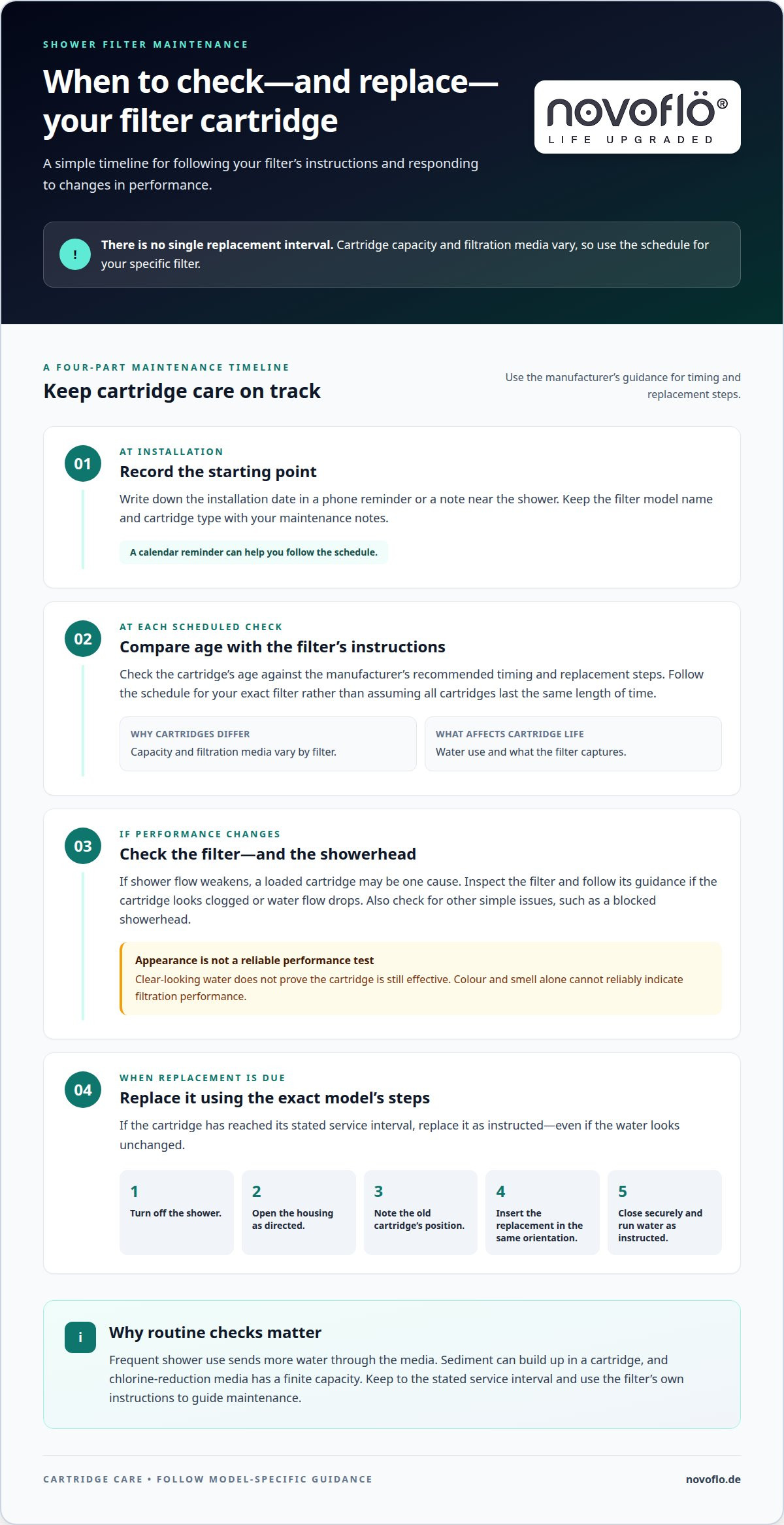
Cartridges do not all have the same replacement interval. Follow the schedule for your specific filter, since capacity and filtration media vary. Read the manufacturer’s instructions before installation to find the recommended timing and replacement steps. A calendar reminder can help you follow that schedule.
Cartridge life depends on water use and what the filter captures. A frequently used shower sends more water through the media than one used occasionally. Sediment can also build up in a cartridge, and chlorine-reduction media has a finite capacity. Appearance alone cannot show whether filtration is still working, so do not assume clear water means the cartridge remains effective.
- At installation: Write the date on a note near the shower or in a phone reminder.
- At each scheduled check: Compare the cartridge’s age with the manufacturer’s replacement instructions.
- After a change in performance: Inspect the filter and follow its guidance if water flow drops or the cartridge looks clogged.
If shower flow weakens, a loaded cartridge may be one cause. Check for other simple issues, such as a blocked showerhead. If the cartridge has reached its stated service interval, replace it as instructed, even if the water looks unchanged. Colour and smell alone cannot reliably indicate filtration performance.
Follow the replacement steps for your exact filter model. Turn off the shower, open the housing as directed, and note the old cartridge’s position before removing it. Insert the replacement in the same orientation, close the housing securely, then run water as instructed. Keep the model name and cartridge type in your maintenance notes to avoid confusion at the next replacement.
How shower filters may help maintain colour-treated hair
A shower filter may support colour care by reducing targeted contaminants in incoming water. Its performance depends on the filtration media and the claims supported by testing.
Effects on Blonde Hair
Natural blonde and bleached blonde hair start from different baselines. Bleaching changes the hair; untreated blonde hair has not undergone that chemical process. Sonja described bleached hair becoming brittle and taking on unwanted tones after dyeing. Her experience illustrates why colour-treated hair may need extra care, but it does not establish that shower water causes every colour shift.
Assess your hair and note when dryness, tangling or colour changes appear, such as after bleaching or repeated washing. Then consider whether the filter targets a contaminant relevant to your water and routine.
Potential Colour Maintenance Benefits
A filter can reduce exposure to contaminants its media is designed to target. This makes it a preventive step at the shower, not a treatment for split ends or breakage. For example, a filter designed to reduce chlorine may lower chlorine in the water passing through it. It will not restore colour that has already changed or replace salon care.
When assessing shower-filter certifications or test results, look for documentation that names the contaminant, explains the test conditions and supports the reduction claim. Confirm that the results apply to the specific filter model rather than relying on a broad filtration claim.
Use filtration alongside colour-safe washing and gentle handling. Track changes in how your hair feels or looks across your usual routine, then consider whether they relate to the filter’s stated target.
Safety and Limitations
Are shower filters safe for skin and hair, and what are their limitations? A correctly installed filter used as directed is intended to treat shower water, but its performance depends on the media, maintenance and target contaminant. Follow its instructions and replace cartridges on schedule.
A shower filter’s effects depend on what it is designed to treat, and it should not be expected to repair hair damage. For example, a filter designed to reduce chlorine should not be assumed to reduce sediment or hardness. Match the filter’s stated capabilities to your concern, and continue using colour-care products and gentle styling.
Installation and showerhead compatibility
Check that a filter fits your shower before considering its filtration performance. Identify your setup, such as a fixed showerhead, handheld shower or hose connection, since these may require different connection points. Compare your fittings with the filter’s installation instructions rather than assuming it will attach directly to any showerhead.
Check where water enters the showerhead. A filter may fit between the water outlet and showerhead, while another design may connect differently. Follow the product instructions for placement and connection, and make sure there is enough clearance for the filter, especially beside a wall or shower rail.
- Identify the setup: Note whether your showerhead is fixed, handheld, or attached to a hose.
- Inspect the connection: Look at the joint where the showerhead or hose meets the water outlet.
- Compare instructions: Match the connection and installation method to the filter’s guidance.
- Plan access: Make sure you can reach the housing later for cartridge replacement.
Follow the manufacturer’s installation steps. Turn off the water before disconnecting fittings, and keep the original showerhead and removable parts nearby. Position seals as directed and tighten connections carefully. After installation, run water and inspect each joint for leaks. If a connection leaks, stop and reseat it according to the instructions rather than forcing the fitting.
Water flow matters, too. A filter adds a component to the shower path, so follow its operating directions and note any change after fitting. For example, weaker flow may come from a poorly seated connection, a clogged showerhead, or a filter cartridge needing attention. Check these points in order before assuming the filter is incompatible.
For a filter designed around domestic water conditions in Egypt, explore the shower filter option and compare its installation guidance with your shower setup.
Novoflö: Novoflö shower filter
The Novoflö shower filter is designed for domestic water conditions in Egypt. Its German-engineered filtration reduces chlorine and targeted impurities in shower water, supporting a considered hair-care routine for colour-treated blonde hair. Use it to address water exposure alongside careful washing and styling, not as a substitute for colour care or a treatment for damaged strands.
Before choosing a filter, compare its stated purpose with your concern and review its cartridge and installation instructions. Novoflö offers a focused shower-water filter, not a whole-house system or water softener. If you want to address shower-water exposure, explore the Novoflö shower filter at novoflo.de.
Make your next hair-care choice with confidence
Blonde hair care involves a series of choices, not a single fix. If you are considering a shower filter for bleached blonde hair, focus on the contaminants it is designed to reduce and whether it fits your shower. Clear expectations help you choose a practical step without expecting one product to address every cause of dryness, breakage or colour change.
Keep your routine intentional. Give each product a clear role, follow its care instructions and assess it against that role rather than broad promises. This measured approach helps you make choices that suit your hair and daily habits.
If improving shower-water filtration is the step you want to explore, discover Novoflö’s shower filter. Build your routine around informed choices, and give your blonde hair care the attention it deserves.
Frequently Asked Questions
Why does tap water make blonde hair look brassy or dull?
Minerals or other residues in tap water may build up on hair and contribute to dullness. Brassiness can also follow bleaching, dyeing or sun exposure, so water is not the only possible cause. If your hair’s tone shifts after colouring rather than after washing, review the colour process as well as your shower routine. Appearance alone cannot identify the cause.
Can shower filters remove chlorine and chloramine from tap water?
Some shower filters are designed to reduce chlorine, but chloramine removal depends on the filter media and supporting test results. Do not assume a chlorine-reduction claim also covers chloramine. Check whether the product identifies each contaminant separately and provides evidence for its reduction. Novoflö’s stated filtration purpose is to reduce chlorine and targeted impurities; no chloramine-removal claim is made.
Do shower filters help prevent color fading in bleached blonde hair?
A shower filter may help reduce exposure to targeted contaminants and support a colour-care routine, but it cannot guarantee that bleached blonde colour will not fade. Washing frequency, heat styling, sunlight and the colouring process can also affect colour over time. Treat filtration as one part of your routine, not a substitute for colour-safe products or salon aftercare.
Can hard water cause brassiness, dryness, or buildup on bleached hair?
Hard water contains dissolved minerals that can leave deposits on hair, contributing to a coated feel or dull appearance. Bleached hair may feel especially rough if it is already dry or porous. Mineral buildup does not prove that water caused brassiness, since colour changes have multiple possible causes. If your hair feels coated after washing, consider whether mineral deposits may be a factor before changing your colour routine.
How often should shower filter cartridges be replaced, and what do replacements cost?
For Novoflö’s Essential Shower Filter, cartridges are specified for replacement every 3 months for families and every 4-6 months for individuals. Use the matching replacement cartridge and follow its instructions. Replacement cost depends on the cartridge product and pack size, so compare the listed options before buying. Don’t apply a cartridge schedule from one filter model to another.
How can I tell whether my water contains chlorine, chloramine, or high mineral levels?
A suitable water test can help distinguish chlorine, chloramine and mineral levels. Choose one that reports the specific parameters you want to assess; a general reading may not cover all three. Smell, visible residue or how your hair feels may prompt further investigation, but none reliably identifies a particular contaminant. Keep the test instructions with the results for context.


