


Shower Filter or Water Softener: Choose for Your Living Situation
The shower filter vs water softener decision comes down to the problem you need to solve. A shower filter is generally designed to reduce chlorine and targeted impurities; a water softener reduces hardness minerals such as calcium and magnesium. Choose based on your water concern, not on the assumption that one system does both.
Hard water can leave scale on fixtures and change how water feels, while chlorine and other impurities call for a different kind of treatment. That distinction matters when you’re choosing a solution for your home in Egypt. This guide explains what each option targets, how their costs and upkeep compare, and when combining filtration and softening may make sense. You’ll also find a practical way to decide whether you need a shower filter, a water softener, or both.
Key Takeaways
- Match the treatment to the problem: hardness minerals and chlorine call for different solutions.
- Factor in your living situation, especially whether you own your home and can make changes to its plumbing.
- Compare ongoing cartridge replacement needs with the broader maintenance involved in treating water throughout a home.
- Consider combined filtration and softening only when you need both functions; a shower filter is the focused option for shower-water concerns.
Water Softener vs Shower Filter: Which Do You Need in 2026?
A shower filter vs water softener comparison starts with what you want to treat: hardness minerals or specific contaminants. A shower filter can reduce chlorine and other impurities named for that product, while a softener addresses calcium and magnesium. For chlorine or chloramine, check the filter’s stated treatment claims; performance depends on its filtration media and capabilities.
Ion-Exchange Water Softeners
An ion-exchange softener passes hard water through resin that captures calcium and magnesium, then releases other ions, commonly sodium. This process reduces hardness in the water the unit treats. It doesn’t remove chlorine simply by softening the water, and it isn’t a substitute for filtration when contaminants are the concern.
A tap-connected softener treats water at that outlet. A whole-home unit treats the supply entering the home, extending hardness treatment to multiple taps. The key difference is coverage, not the ion-exchange process.
Shower Filters
A shower filter sits in the shower’s water path and uses filtration media to reduce the contaminants stated for that product. These filters generally target chlorine rather than dissolved calcium and magnesium, so a chlorine-focused filter won’t soften hard water.
Chloramine reduction also depends on the filter’s stated capabilities. Don’t assume a chlorine claim means the filter treats chloramine. Check the treatment target and match it to the concern in your shower water.
| Option | Main target | Coverage | Best fit |
|---|---|---|---|
| Ion-exchange softener | Calcium and magnesium | Connected tap or home supply | Hardness concerns |
| Shower filter | Chlorine and specified impurities | Shower | Shower-water filtration |
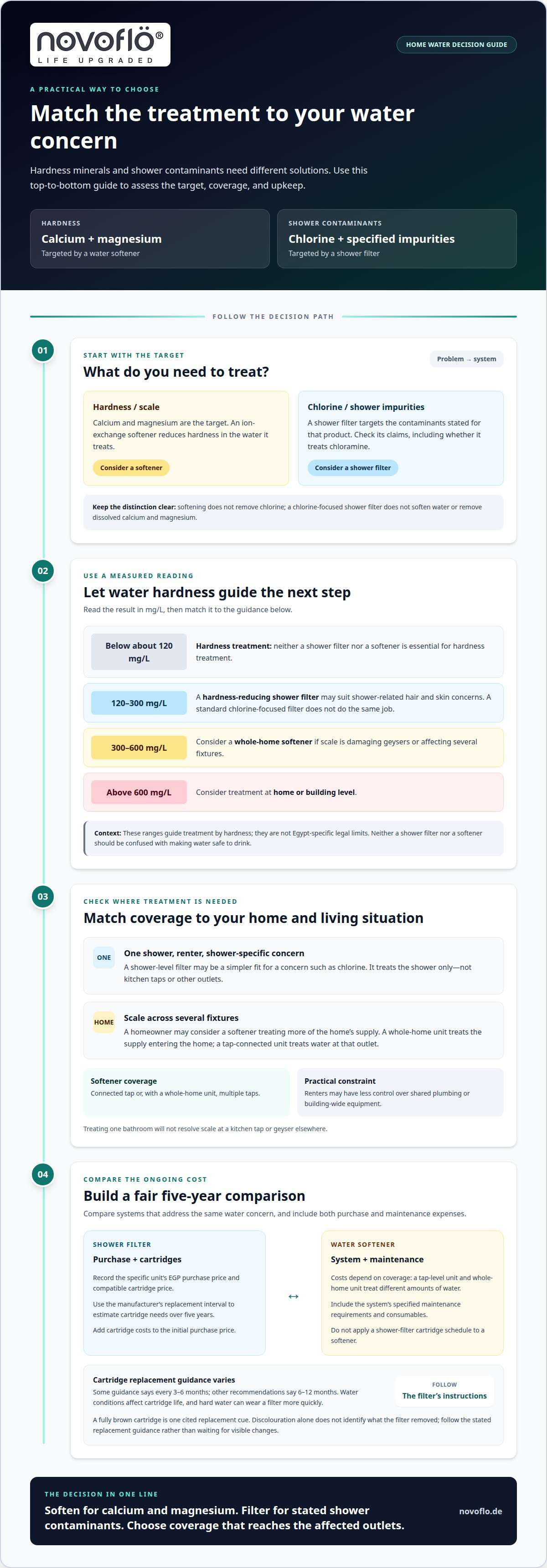
For a shower filter vs water softener decision, match the system to both the water issue and the outlets affected. Choose a softener for hardness across taps; choose a shower filter for specified contaminants in shower water.
Choosing based on home ownership and living situation
In Egypt, the right choice for hard water depends on its measured hardness and where treatment is needed. A chlorine-focused shower filter won’t remove the calcium and magnesium that cause hardness; a softener is designed for that problem.
For renters with a shower-specific concern, such as chlorine, a shower-level filter may be a simpler fit. It won’t treat water at kitchen taps or other outlets. A homeowner dealing with scale across multiple fixtures may consider a softener that treats more of the home’s supply. Choose according to the coverage you need.
Use the hardness reading as a decision guide:
- Below about 120 mg/L: neither a shower filter nor a softener is essential for hardness treatment.
- 120 to 300 mg/L: a hardness-reducing shower filter may suit shower-related hair and skin concerns. A standard chlorine-focused shower filter won’t perform that same task.
- 300 to 600 mg/L: consider a whole-home softener if scale is damaging geysers or affecting several fixtures.
- Above 600 mg/L: consider treatment at home or building level.
These ranges guide treatment by hardness; they aren’t Egypt-specific legal limits. Match the device to the target: chlorine calls for filtration, while calcium and magnesium call for hardness treatment. Neither option should be confused with making water safe to drink.
Home ownership matters because a whole-home softener usually treats the supply where it enters the property. Renters may have less control over shared plumbing or building-wide equipment, so a point-of-use option can be more practical for one shower. Treating one bathroom, for example, won’t resolve scale at the kitchen tap or geyser elsewhere.
Choose based on the hardness level, the affected outlets, and whether you can alter the home’s plumbing. In short, for hard water in Egypt, prioritize a softener when hardness is the issue; select a shower filter for shower-specific contaminants such as chlorine.
Five-year costs and cartridge replacement
A shower filter’s purchase price is only the starting point. Over five years, include replacement cartridges and the filter’s service life in your comparison. In Egypt, compare current EGP prices for the specific unit and its compatible cartridges, rather than relying on overseas estimates.
Replacement timing varies. Guidance commonly places shower-filter cartridge changes every 3 to 6 months, while other recommendations give 6-12 months. Water conditions affect cartridge life, and hard water can wear a filter more quickly. Follow the replacement instructions for the specific filter, and replace a cartridge when it reaches its stated limit.
Colour can also indicate that a cartridge needs attention: a cartridge that has turned fully brown is one cited replacement cue. Sediment and other captured material may cause visible discolouration, but colour alone doesn’t identify what the filter removed. If chlorine reduction is your concern, follow the cartridge replacement guidance rather than waiting for visible changes.
Build a five-year comparison in three steps:
- Record the shower filter’s EGP purchase price and the price of its replacement cartridges.
- Use the manufacturer’s replacement interval to estimate how many cartridges the five-year period requires.
- Add those cartridge costs to the initial purchase price, then compare the result with the other system’s purchase and maintenance expenses.
A water softener has a different cost profile. It treats hardness rather than targeting shower contaminants, so expenses depend on the system’s coverage and ongoing maintenance. A whole-home unit and a tap-level unit don’t treat the same amount of water. Include the maintenance requirements and consumables specified for that system; don’t apply a shower-filter cartridge schedule to a softener.
For a fair five-year comparison, compare like with like: the same treatment goal, the same coverage, and all replacement costs. A shower filter won’t remove calcium and magnesium just because its cartridge needs replacing. Choose based on the water concern first, then calculate upkeep using the product’s instructions and EGP prices.
Water softeners and combined filtration-softening systems
A softener and a filtration system solve different problems. A softener reduces the calcium and magnesium minerals that cause hardness; it doesn’t make water cleaner or safer to drink. For homes dealing with both scale and specific contaminants, a combined system can pair softening with filtration. Match each stage to a distinct water concern.
In a salt-based softener, ion exchange replaces hardness minerals with sodium. Removing 100 mg/L of hardness adds about 46 to 47 mg/L of sodium. A household softener also uses about 190 litres of water per regeneration cycle, so water use belongs in the decision, not just scale control.
Combined systems may use separate treatment stages. For example, a sediment pre-filter can capture particles, while carbon filtration targets certain contaminants and softening resin addresses hardness. A post-filter or UV stage may serve another purpose. These stages aren’t interchangeable: filtration doesn’t automatically soften water, and softening doesn’t remove every contaminant.
Use the level of hardness and the damage it causes to guide the choice. At 300 to 600 mg/L, consider a whole-home softener if scale is damaging geysers. Above 600 mg/L, consider treatment at home or building level. These thresholds guide the hardness response; they don’t identify which contaminants need filtration.
For a home with scale on multiple fixtures and a separate filtration concern, a combined setup may address both needs. For a shower-only concern such as chlorine, whole-home softening provides a different treatment and may be unnecessary. Keep drinking-water needs separate: softened water isn’t automatically safer to drink. Choose a combined system only when both goals matter, and match each stage to its intended job.
Novoflö: Novoflö shower filter
Novoflö’s shower filter is designed for domestic water conditions in Egypt and reduces chlorine and targeted impurities in shower water. It’s a focused option when your concern is shower-water quality and supporting healthier skin and hair, rather than hardness-related scale throughout the home.
The distinction matters. A shower filter doesn’t replace a water softener for reducing calcium and magnesium. If hard-water scale affects multiple fixtures, softening addresses that need. If your priority is reducing chlorine and targeted impurities in the shower, Novoflö offers a direct, science-led step for your daily routine.
Choose the treatment that matches the problem. For shower filtration, contact Novoflö to learn more about its shower filter.
Make your next water decision with purpose
The shower filter vs. water softener decision should start with one priority: the change you want in your daily routine. Avoid choosing a system just because it sounds more comprehensive. A focused solution can be the more practical first step when it addresses the concern that matters to you.
Think beyond the device itself. Consider how the choice fits your household, which areas of the home are affected, and what maintenance you’re prepared to manage. This keeps the decision grounded in everyday use rather than broad claims or assumptions. It also helps you decide whether to act now or plan for wider treatment later.
If shower filtration is the right next step for your needs, start a conversation with Novoflö. Take the time to choose deliberately, then make a change that feels right for your home.
Frequently Asked Questions
What Is Hard Water and How Does It Affect Your Hair?
Hard water contains dissolved minerals, mainly calcium and magnesium. These minerals can leave residue on hair and make it feel coated, rough, or harder to rinse clean. Dull hair after washing may prompt a closer look at water hardness, but that feeling alone doesn’t prove hard water is the cause. A filter targeting chlorine won’t remove hardness minerals.
Is softened water safe to drink?
Softened water isn’t automatically safer to drink, because softening addresses hardness rather than making water cleaner. Salt-based ion exchange adds sodium as it reduces hardness. The amount depends on how much hardness the system removes, so household drinking-water needs and sodium considerations matter. A softener’s presence alone doesn’t establish whether the original supply is suitable for drinking.
What Else Do Shower Filters Miss?
A shower filter treats water passing through the shower, not the entire home’s supply. Don’t assume it removes every impurity or improves drinking water. Its ability to address a contaminant depends on its filtration media and stated treatment claims. It won’t resolve mineral scale on a kitchen tap unless that water passes through a suitable treatment system.
How does a shower filter work compared with a water softener?
A shower filter places filtration media in the shower’s water path; a softener uses ion exchange to address hardness. Consider a bathroom with chlorine concerns at the shower and scale on several taps: one treatment goal won’t automatically solve the other. Compare each device’s purpose and coverage, not just its installation point or general claims about water quality.
What contaminants and minerals does a shower filter remove?
What a filter removes depends on its media and stated capabilities. Novoflö’s shower filter is designed to reduce chlorine and targeted impurities, including heavy metals, VOCs, micro-plastics, bacteria, rust, iron sediment, agricultural runoff, residual disinfectants, and organic impurities. Shower filters aren’t generally designed to remove calcium and magnesium hardness minerals. Don’t assume every filter addresses the same contaminants; a product’s stated capabilities define its scope.
What does a water softener remove, and how does ion exchange work?
A water softener reduces calcium and magnesium, the minerals responsible for water hardness. In ion exchange, resin captures those minerals and releases other ions, commonly sodium in salt-based systems. The result is softened water, not filtration for every contaminant. For example, a softener can address mineral buildup while leaving a separate chlorine concern for an appropriate filtration stage.


