


Is a Shower Filter Worth It? Weigh the Costs and Benefits
A shower filter is worth considering if you want to reduce chlorine and other targeted impurities in your shower water, but it won’t solve every water problem. A shower filter may help with some water concerns, but it may not address every issue with your water. Whether it suits you depends on your water concerns and whether you’re comfortable replacing the cartridge as directed.
If your hair feels dry or hard to manage after showering, it’s reasonable to look beyond hair products. This guide explains what shower filters can and can’t do, what their potential benefits for hair mean, and how cartridge replacement affects ongoing use. You’ll also learn what to consider when comparing shower filters in Egypt, including what comes with a product and what you may need to replace. First, let’s look at the water concerns a shower filter can address, and those it can’t.
Key Takeaways
- Match a shower filter to the impurities it’s designed to reduce, and remember that filtration doesn’t soften hard water.
- Plan for cartridge replacements based on water conditions and shower use, since upkeep affects long-term value.
- Look for clear performance information, including relevant certification, before weighing potential hair benefits.
- Explore Novoflö’s shower filter if reducing chlorine and targeted impurities is the goal of your shower routine.
Do Shower Filters Work and Are They Worth It?
A shower filter can reduce specific contaminants, but it won’t solve every water problem. Is a shower filter worth it? It can be, if its filtration targets match your concern and you’re looking for shower-point treatment rather than broader water treatment.
Contaminants Shower Filters May Reduce
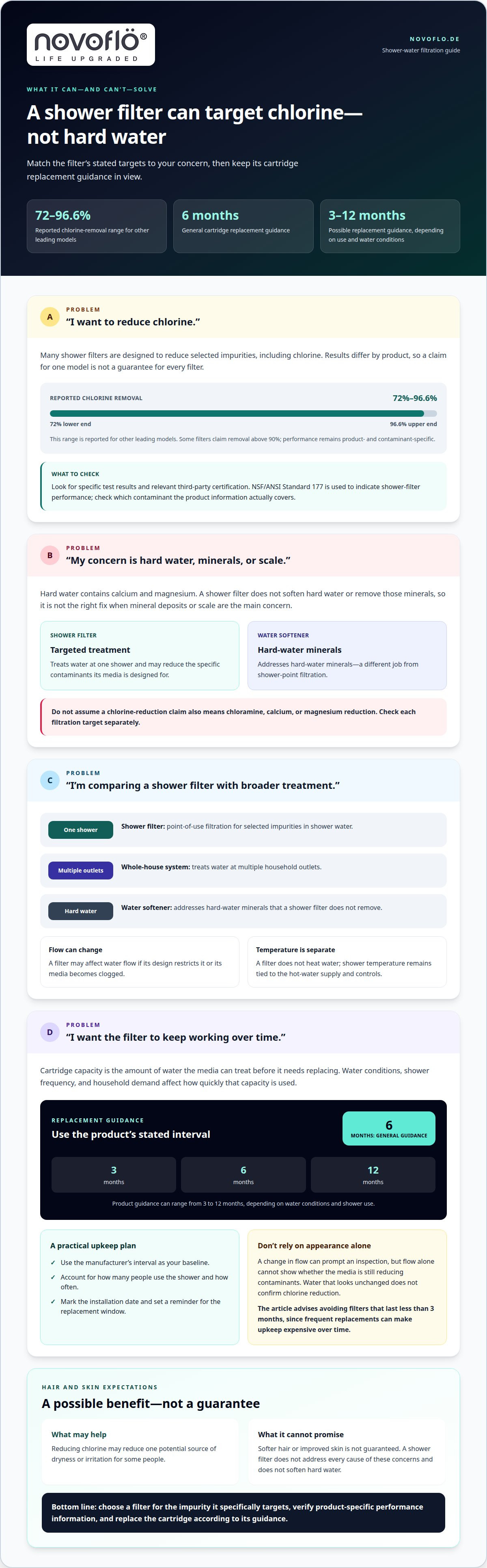
Shower filters are designed to reduce selected impurities, with chlorine among the contaminants addressed by many models. Research reports chlorine-removal results ranging from 72% to 96.6% for other leading models, while some filters remove over 90%. Those results don’t mean every filter removes every contaminant.
Chloramine, hard-water minerals, and scale need separate consideration. Don’t assume a filter reduces chloramine unless its performance information specifically says so. Hard water contains calcium and magnesium, which shower filters don’t soften or remove. If mineral deposits or scale are your main concern, a shower filter isn’t the right solution.
How Shower Filters Remove Contaminants
A shower filter passes water through media designed to target particular contaminants before it reaches the showerhead. Its materials and design determine what it can reduce. A claim about chlorine reduction, for example, doesn’t establish performance against chloramine or calcium and magnesium.
A filter designed to reduce chlorine may help address that contaminant while leaving hard-water minerals unchanged. Match the stated filtration targets to the concern you want to address. To maintain the intended performance, replace the cartridge as directed.
Testing Filter Performance
Testing contaminant reduction means comparing water before and after filtration under defined conditions. For chlorine, the result is expressed as the percentage removed. Reported results vary: other leading shower filter models show a 72-96.6% chlorine-removal range, and some models claim removal above 90%.
Treat performance information as specific to the product and contaminants tested, not as a promise that every shower filter works alike. Check whether the claim concerns chlorine, chloramine, or another impurity. The useful question is whether the product’s stated filtration targets match your concern.
Comparing Filter Options and Shower Effects
A shower filter treats water at one shower, while a whole-house system treats water at multiple household outlets. A water softener addresses hard-water minerals, which a shower filter doesn’t remove. If your main concern is calcium, magnesium, or scale, a shower filter isn’t a substitute for softening.
Is a shower filter worth buying compared with a whole-house filter or water softener? Yes, when the goal is targeted shower-water filtration; it isn’t a replacement for whole-house treatment or softening. A filter can affect flow if its design restricts water or its media becomes clogged. It doesn’t heat water, so shower temperature remains tied to the hot-water supply and controls.
Filter capacity and replacement frequency
A shower filter’s capacity is how much water it can treat before its media needs replacing. In Egypt, water quality, household demand, and shower frequency all affect how quickly that capacity is used.
Filter Capacity
The more water passes through a cartridge, the sooner it may need replacing. A busy household may use up a cartridge’s capacity sooner than a person who showers less often.
The filtration media must target the contaminant you want to reduce. A filter designed for chlorine doesn’t automatically address calcium or heavy metals. Carbon is used in some filter designs, but the material alone doesn’t tell you what a shower filter can remove. Check the specific product’s filtration targets and replacement guidance.
Replacement Frequency and Intervals
Shower filters generally need replacement every six months to maintain effectiveness, though actual timing varies with use. Replacement guidance can range from 3 to 12 months, depending on water conditions and shower use.
Use the product’s stated interval as your baseline, then account for household demand. A cartridge used by several people may process more water than one used less often. Avoid filters that last less than 3 months, since frequent replacements can make upkeep expensive over time. A scheduled replacement keeps you from relying on exhausted media.
Signs a Filter Needs Replacing
The clearest sign is reaching the manufacturer’s replacement interval. Mark the install date on a calendar, then set a reminder for the stated replacement window. For example, a six-month guideline gives you a practical point to reassess the cartridge.
A noticeable change in water flow can also prompt you to inspect the filter and showerhead. Don’t use flow alone to judge whether the media is still reducing contaminants. Replace the cartridge according to its guidance even if the water looks unchanged, since you can’t reliably judge chlorine reduction by sight.
For a filter designed around Egypt’s domestic water conditions, explore the shower-filter details and its replacement guidance.
What are the potential benefits of using a shower filter for hair health?
Shower water can affect how skin and hair feel, but a filter’s benefits depend on what it reduces. A filter that targets chlorine may suit someone concerned about chlorine in shower water. It won’t remove every contaminant or address hard-water minerals.
Reducing chlorine in shower water may help reduce one potential source of dryness or irritation, but it doesn’t guarantee softer hair or improved skin. It won’t address every cause of these concerns, and a shower filter doesn’t soften hard water or remove calcium and magnesium. Match the product’s targets to your concern rather than expecting one filter to solve everything.
For performance, look for specific test results and third-party certification relevant to the contaminant named in the product claims. NSF/ANSI Standard 177 is a standard used to indicate shower-filter performance. Its name alone doesn’t show which contaminants a particular product reduces. Check whether the product’s stated testing covers chlorine, chloramine, or another target, and whether the certification applies to the finished filter.
Certification and testing matter because words such as “filtered” and “natural” don’t prove contaminant reduction. Look for a clear claim that identifies the substance targeted and the performance information provided. Evidence about chlorine reduction, for example, doesn’t establish that the same filter removes minerals or heavy metals. Treat each claim as specific to its stated target, not as a promise of broader purification.
To install a filter on a standard Egyptian shower, turn off the water, unscrew the showerhead, and fit the filter between the connection and head if the design allows. Follow the product instructions, restore water, and check for leaks. Maintain it by replacing its cartridge at the stated interval; the correct fitting and steps depend on the filter design.
Shower filter products and prices
Compare shower-filter prices in EGP by what each purchase includes, not by the headline figure alone. Some listings may cover the filter housing, while others may include replacement cartridges. Is a shower filter worth it for your budget? The answer depends partly on the components you’ll need to buy separately.
Before choosing, compare the product’s filtration targets, included parts, and replacement guidance. Is a shower filter worth it if the listed price doesn’t include replacement media? Consider the filter and the cartridges needed to keep it in use, rather than treating the initial purchase as the whole cost.
- Included components: Check whether the purchase contains a filter housing, cartridge, or both.
- Replacement access: Confirm that the matching cartridge is available as a separate product.
- Performance details: Compare the specific contaminants named in the product’s claims.
Comparing included parts and replacement media makes it easier to understand what you’re buying and plan for ongoing use. Focus on the specific product’s stated filtration purpose and what comes with it, rather than assuming that a lower listed price represents better value.
For example, product information that explains both filtration targets and included components gives you a firmer basis for comparing options. Review the shower filter’s product details alongside those criteria before deciding what fits your routine.
Novoflö: Novoflö shower filter
The Novoflö shower filter is designed to reduce chlorine and targeted impurities in shower water. German-engineered for domestic water conditions in Egypt, it brings targeted filtration to your daily shower routine. It’s for shower-water filtration, not whole-house treatment or water softening.
Consider Novoflö if reducing chlorine and targeted impurities in shower water is your priority and you’re prepared to replace the cartridge as directed. If your main concern is hard water, calcium, magnesium, or scale, a shower filter won’t soften the water or remove those minerals. Choose a filter based on the water concern it’s designed to address.
For a shower filtration option focused on Egypt’s domestic water conditions, contact Novoflö to discuss the Novoflö shower filter.
Make Your Next Shower-Water Decision
Deciding whether a shower filter is worth it starts with a clear priority, not another beauty promise. Identify what you want to change about your shower routine, then check whether the filter targets that concern. This helps you avoid expecting one product to solve unrelated water problems or every hair and skin concern.
Think of filtration as one practical part of personal care, alongside the products and habits you already rely on. Ask whether targeted shower-water treatment fits your needs and whether you’re prepared to replace the cartridge as directed. That gives you a decision based on your routine and water concern, rather than broad claims.
If you’re considering a targeted shower filtration option, contact Novoflö with your shower filter questions. Take the next step with a clear goal and expectations grounded in what a shower filter is designed to do.
Frequently Asked Questions
How can using unfiltered water impact your skin and hair?
Shower water may contain chlorine and other impurities, but symptoms alone can’t identify a specific contaminant. If you notice dryness after showering, consider whether chlorine reduction is relevant alongside your shampoo, cleanser, and bathing routine. Water chemistry varies, and a filter only targets substances its media is designed to reduce.
What contaminants can shower filters remove, and what can’t they remove?
Shower filters may reduce contaminants such as chlorine, depending on their filtration media and tested performance. Novoflö states that its filter targets chlorine, heavy metals, VOCs, microplastics, bacteria, rust, iron sediment, agricultural runoff, residual disinfectants, and organic impurities. A shower filter may not address hard water, so check whether its filtration media is designed for your concern. Match the product’s stated targets to your concern rather than assuming filtration removes everything.
What are the health and skin benefits of using a shower filter, according to evidence?
A filter’s clearest benefit is reducing the specific contaminants its performance information covers. Reducing chlorine in shower water may support a more comfortable routine for people concerned about dryness or irritation, but filtration isn’t a medical treatment. A chlorine-reduction claim doesn’t establish benefits for every skin condition. Judge the product by its stated filtration targets, not broad wellness promises.
Are shower filters effective for eczema, dry skin, or hair damage?
A shower filter may address a water-related factor, but it doesn’t cure eczema or treat hair damage. If dryness or irritation is a concern, consider water exposure alongside other routine factors, such as hot showers or hair products. A chlorine-targeting filter addresses chlorine, not every possible cause. Persistent eczema or worsening symptoms need appropriate medical care, rather than reliance on a shower accessory alone.
How often should shower filter cartridges be replaced, and how much water do they treat?
Replacement timing depends on the cartridge and household use, while water volume depends on the product’s rated capacity and water conditions. For Novoflö cartridges, the stated lifespan is 3 months for families; 4-6 months for individuals. That interval is a practical guide, not a universal water-volume figure. Check the specific cartridge’s capacity rating and replacement instructions, since shower frequency affects how quickly its media is used.
What are the best shower filter types and filtration media to compare?
The best comparison starts with the contaminant you want to reduce, then considers media, test evidence, fit, and cartridge upkeep. Carbon and KDF-55 are examples of filtration media; Novoflö lists KDF-55 among its filter layers. Don’t choose by material name alone. Check which contaminants the complete filter is designed to target, what performance claims apply, and how its cartridge replacement schedule fits your household.


