


Shower Filter Without Plumbing Changes: Compare Inline Options
The easiest shower filter to install isn’t necessarily the right one for your water. An inline shower filter without plumbing changes fits between your existing shower connection and showerhead, adding filtration without rerouting pipes.
A simpler setup makes sense, especially if your main concern is chlorine rather than a full plumbing project. But filter media matters: different technologies target different impurities, and a compact shower cartridge is not a water softener.
This guide explains how inline filters work, compares common filtration technologies and outlines what to consider when assessing chlorine reduction. You’ll also learn how cartridge replacement affects ongoing costs, so you can weigh convenience against maintenance when choosing a shower filter in Egypt.
Key Takeaways
- Choose filtration media based on the contaminant it targets; chlorine reduction and water softening are different jobs.
- Understand how an inline filter connects between your shower arm and showerhead before comparing options.
- Factor cartridge replacement into ongoing costs, since maintenance intervals vary by filter and use.
- Compare technologies by their target impurities and chlorine-reduction performance to find the option that fits your shower routine.
Cartridge maintenance and replacement costs
Replacement timing affects both filtration and ongoing costs. Compare the cartridge interval, replacement method and delivery options before choosing a shower filter.
Replacement Frequency and Filter Lifespan
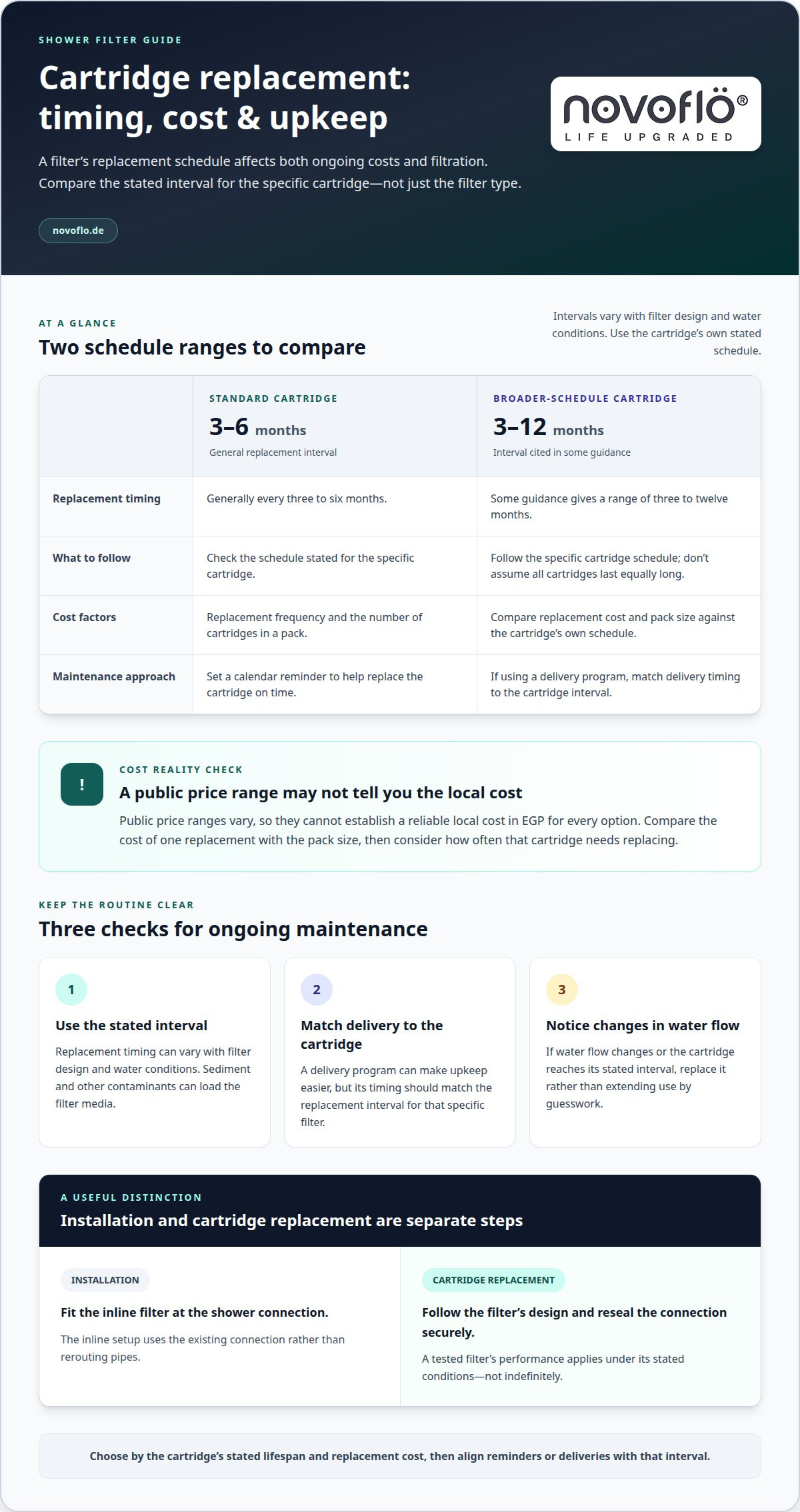
Shower-filter cartridges generally need replacing every three to six months. Some guidance suggests a broader interval of three to twelve months, so follow the schedule stated for the specific cartridge. Replacement intervals vary with filter design and water conditions. Sediment and other contaminants can load the filter media, and a calendar reminder can help you replace the cartridge on time.
Cartridge Replacement Costs
Cartridge costs depend on the replacement type, pack size, and how often the filter needs a new cartridge. Compare the cost of one replacement with the number included in a pack, then consider the schedule across a year. Public price ranges vary, so they cannot establish a reliable local cost in EGP for every option.
A replacement-filter delivery program can make maintenance easier by matching deliveries to the cartridge’s replacement interval. Check that the delivery timing matches the schedule for your specific filter instead of assuming every cartridge lasts the same amount of time. A cartridge replaced every three months, for example, needs a different delivery schedule from one replaced every six months.
Installation and replacement are separate steps. To install an inline filter, fit it at the shower connection; when replacing its cartridge, follow the filter’s design and reseal the connection securely. If water flow changes or the cartridge reaches its stated interval, replace it instead of extending use by guesswork. A tested filter’s performance applies under its stated conditions, not indefinitely.
| Option | Replacement timing | Cost consideration | Maintenance approach |
|---|---|---|---|
| Standard cartridge | Three to six months generally | Replacement frequency and pack size | Set a calendar reminder |
| Broader-schedule cartridge | Three to twelve months in some guidance | Follow the specific cartridge schedule | Match delivery to its interval |
Choose a filter based on its stated cartridge lifespan and replacement cost, then match any delivery schedule to that interval.
Chlorine and disinfection byproduct reduction
Chlorine reduction depends on the filter media and the water tested. A chlorine claim alone doesn’t show which other contaminants or disinfection byproducts the filter targets.
Filter Media for Chlorine Reduction
Filter media is the material water passes through to reduce targeted substances. Different media can work differently, so compare a filter’s stated target and test conditions rather than relying on the word “natural.” Test results for shower filters used baseline chlorine concentrations between 1.68 and 2.7 PPM. A baseline alone shows starting conditions, not how much chlorine a filter removes.
For a practical comparison, test water samples taken before and after filtration. This can help show what the filter addresses under the test conditions. Consider the chlorine result alongside the testing details. A claim about chlorine shouldn’t automatically be taken as a claim about every contaminant or disinfection byproduct.
Chlorine and Contaminant Removal
Showerhead filters are generally designed to address chlorine, not soften hard water. Calcium and magnesium are minerals associated with water hardness, and removing chlorine doesn’t mean a cartridge removes those minerals. Some shower filters may also reduce sediment or heavy metals, but that depends on the filter media and its testing.
Vitamin C contains ascorbic acid, which is used to dechlorinate water after mains disinfection. That use doesn’t provide a dosing method for household shower water. Avoid improvising a DIY treatment by adding vitamin C to a shower: concentration, contact time and consistent delivery matter. A purpose-designed filter with a stated target makes for a clearer comparison.
Disinfection byproducts are a separate concern from free chlorine. Don’t assume that reducing chlorine proves a filter removes byproducts. Look for test results that identify the specific substance and compare samples before and after filtration. For homes in Egypt, ask a direct question: which contaminant was tested, and what changed in the filtered sample?
How do Shower Filters Work?
An inline design alone doesn’t establish a shower filter’s safety or certification. Health claims should match product-specific test results that name the contaminant tested and measured reduction. Filtration alone doesn’t prove benefits for skin and hair.
An inline filter sits between the shower arm and shower head, so installation uses the existing connection rather than rerouting pipes. Most homes use 1/2-inch NPSM shower threads, while some use 3/4-inch threads. Match the filter connections to the shower arm and showerhead before installation. A mismatch can prevent a tight fit or disrupt water flow.
To install an inline filter, remove the showerhead, attach the filter to the shower arm, then reconnect the showerhead to the filter. Tighten threaded joints securely and run water to check for leaks. A shower filter without plumbing changes still needs compatible connections, so check the thread size before installation.
Carbon and vitamin C filters use different approaches to chlorine reduction. Carbon media adsorbs certain substances as water passes through it. Vitamin C, or ascorbic acid, reacts with chlorine and is also used to dechlorinate water after mains disinfection. These mechanisms aren’t interchangeable, so compare the specific chlorine target and test conditions rather than judging by the media name alone.
Neither approach automatically addresses water hardness. Calcium and magnesium cause hard water, and showerhead filters are generally designed to address chlorine rather than soften water. Reducing chlorine doesn’t establish a reduction in calcium, sediment or heavy metals. Those require their own stated targets and evidence.
Compare filtration effectiveness using tests that identify the substance measured and show results before and after filtration. A chlorine test, for example, can assess chlorine reduction, but it can’t prove removal of every contaminant or disinfection byproduct. Keep the claim precise: the tested substance, test conditions and reported result define what the filter has demonstrated.
Inline shower filter brands and technologies
In Egypt, compare shower-specific inline filters by their stated media and target contaminants, not brand names alone. Availability varies by seller, so the useful comparison is what each option is designed to reduce and how it fits your shower setup.
The technology matters. Carbon media and vitamin C are two approaches used in shower filtration, but they work differently. Carbon media adsorbs certain substances as water passes through, while vitamin C, or ascorbic acid, reacts with chlorine. Compare test results for the target contaminant and test conditions, not just the media label.
Water flows through a shower filter’s media before reaching the showerhead, so the housing and media design affect how water moves through the unit. If your water pressure already feels weak, don’t assume every inline filter will behave the same way. Compare product-specific flow information and connection design.
Hard water needs a different solution. Calcium and magnesium contribute to water hardness, and a shower filter designed to reduce chlorine isn’t automatically a water softener. Water softening uses ion exchange and requires contact time, a full-size tank and brine regeneration. A compact shower cartridge doesn’t perform that process.
Keep the purpose clear: filtered shower water isn’t the same as drinking water, and a shower filter shouldn’t be treated as a drinking-water purifier. Choose according to the shower contaminant you want to target, then compare the filter’s stated evidence and replacement needs. Describing filter media as “natural” doesn’t establish what it removes.
For a direct comparison, assess each option by media, target contaminant, test evidence, connection fit, and water-flow information. Start with the problem you want to address, such as chlorine rather than hardness, then select the matching technology. Explore chlorine-focused shower filtration as one option for a shower-specific setup.
Novoflö: Novoflö shower filter
The Novoflö shower filter is a German-engineered filtration system designed for domestic water conditions in Egypt. It reduces chlorine and targeted impurities in shower water, supporting a better foundation for skin and hair care.
Choose it if your priority is reducing chlorine in your everyday shower, rather than softening hard water or filtering water throughout your home. Novoflö focuses on personal shower use, making it a relevant option after you’ve compared inline filters and the contaminants they target. Keep your choice tied to the specific concern you want to address: chlorine reduction, not every water-quality issue.
If you’re considering a Novoflö shower filter for your routine, contact Novoflö to discuss the next step.
Make your next shower upgrade a deliberate one
Choosing a shower filter without plumbing changes can be practical, but the right option depends on your priorities. Decide what you want to address, what evidence matters to you and how much ongoing maintenance you’re comfortable with. These answers make product comparisons more useful than choosing by appearance or broad promises.
Keep your goal specific. A personal-care upgrade should suit your shower routine and the result you’re seeking. Consider whether targeted shower filtration aligns with that goal, then choose with clear expectations.
If you’re considering Novoflö, contact Novoflö about your water needs and discuss whether its shower filter suits your routine. You can make your next step informed, focused, and right for your household.
Frequently Asked Questions
Does water flow speed really change how a filter works?
Water flow can affect how long water contacts filter media, which may influence filter performance. A sudden change in pressure can also affect your shower experience. Novoflö’s shower filter is designed not to reduce water pressure, which it maintains and may improve. If you notice a change after fitting a filter, check for a blocked showerhead, a clogged cartridge or a loose connection before assuming the media is responsible.
How do shower filters install without plumbing changes?
Most inline models attach at the existing shower connection, so installation doesn’t require rerouting pipes. For Novoflö, remove the showerhead, connect the filter to the shower arm, then reattach the showerhead. It fits a standard ½-inch shower connection and installs in under 60 seconds. If clearance between the shower arm and wall is under 32 mm, an adapter is recommended.
What types of shower filters fit standard showerheads and hoses?
Inline filters fit between a shower arm and a fixed showerhead; other designs may connect to a hose. Match the connection type to your shower setup before buying. Novoflö fits standard ½-inch shower connections. For a handheld shower, identify whether the filter connects at the arm or hose, as the connection point determines fit.
Which shower filters reduce chlorine, sediment, and odors effectively?
Choose a filter with stated targets and evidence for the substances you want to reduce. Novoflö’s multi-layer filtration is designed to reduce chlorine, sediment, rust, heavy metals, VOCs, micro-plastics and bacteria. Don’t assume a chlorine claim also means odor reduction. If chlorine smell is your concern, look for product evidence tied to chlorine reduction rather than a broad promise about every odor.
Do shower filters remove hard-water minerals or only reduce chlorine?
Most shower filters target chlorine, not hard-water minerals. Calcium and magnesium cause water hardness, and a filter that reduces chlorine doesn’t thereby remove them. Water softeners use ion exchange, which requires contact time, a full-size tank and brine regeneration. Choose a shower filter for its stated shower-water targets, not as a substitute for a water-softening system.
How often should shower filter cartridges be replaced?
Follow the cartridge schedule for the specific filter. Novoflö recommends replacing cartridges every 3 months for families and every 4-6 months for individuals. Its 3-pack supplies 9 months of filtration when each cartridge is used for 3 months. Keep the replacement interval in your calendar, and install a fresh cartridge when its scheduled service period ends.


