


Shower Filter for Microplastics: How Use Affects Performance
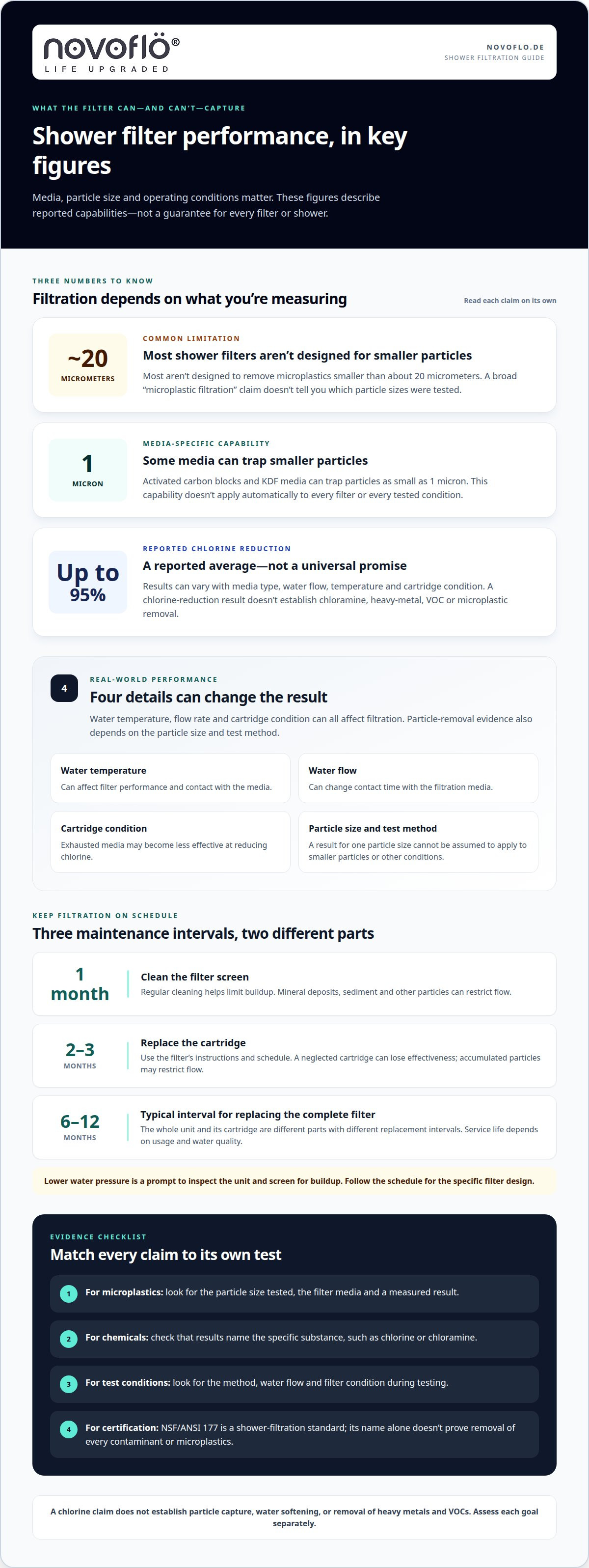
A shower filter for microplastics won’t automatically remove every particle. Most shower filters aren’t designed to remove microplastics smaller than about 20 micrometers, while filters using activated carbon blocks and KDF media can trap particles as small as 1 micron. The filter media matters.
It makes sense to expect cleaner shower water to support a more comfortable routine. But a filter’s performance depends on how it’s used. Water temperature, flow rate and a cartridge that’s past its useful life can all affect filtration.
Here, you’ll learn what shower filters may remove, how temperature and flow affect performance, and what to consider for skin, hair and cartridge changes. The goal is to clarify what filtration can do, and where its limits are, before you choose a shower routine for your home in Egypt.
Key Takeaways
- Understand how chlorine reduction may affect shower comfort for skin and hair, and why filtration is not a cure-all.
- Keep performance in view by cleaning the filter screen monthly and following a consistent cartridge replacement routine.
- Learn why filter media and independent testing matter when judging what a shower filter can remove.
- See how water temperature and flow can change contact time with filter media, helping you assess real-world performance.
Which is better for skin and hair?
For skin and hair, chlorine reduction is the clearest point of comparison. Shower filters are reported to achieve up to 95% average chlorine reduction. That figure describes a reported average, not a promise for every filter, household, or water supply in Egypt. Media type, water flow, temperature, and cartridge condition all affect performance.
Chlorine and chloramine are different disinfectants. A filter shown to reduce chlorine hasn’t automatically demonstrated chloramine reduction. Look for test results that name the specific chemical and state the conditions tested. Without those details, a general claim about “chemical removal” doesn’t explain what happens to chloramine in your shower.
Chlorinated water can leave some people with dry-feeling skin or rough-feeling hair after a shower. Some dermatologists recommend shower filters, particularly for people with sensitive skin, eczema or dry hair. Reducing chlorine may support a more comfortable routine, but it doesn’t treat eczema or replace skin care. Look for measured chlorine reduction, not promises to fix a skin condition.
Heavy metals and VOCs need separate scrutiny. A filter that reduces chlorine may not reduce lead, other heavy metals or volatile organic compounds. A chlorine-reduction claim, for example, says nothing by itself about lead. Check whether testing names each contaminant and identifies the filter media. Broad phrases such as “filters remove impurities” lack the detail needed to assess these claims.
NSF/ANSI 177 is a standard for shower filtration. A certified claim should identify the standard and the specific performance tested; it shouldn’t be read as proof of removing every contaminant. Shower filtration also differs from drinking-water treatment. Hard water minerals are another issue: chlorine reduction doesn’t establish that a filter softens water. Separate these goals before judging skin and hair claims.
Compare results under stated test conditions, then focus on your main concern. If chlorine is your priority, look for chlorine-specific performance. If you’re concerned about heavy metals or VOCs, look for results naming those substances. For a shower filter for microplastics, assess particle-removal evidence separately rather than assuming chlorine reduction proves broad-spectrum filtration.
How often do I need to replace filter cartridges?
Replace a shower filter cartridge every 2 to 3 months, and clean its screen every month. The main drawbacks of neglected filtration are reduced effectiveness, bacterial buildup, and low water pressure.
Cartridge Maintenance and Replacement
Cartridge maintenance includes cleaning the screen and replacing the media according to the manufacturer’s schedule. Accumulated particles can restrict flow, while exhausted media may become less effective at reducing chlorine. Follow the filter’s instructions when fitting a cartridge, and seat it correctly to prevent leaks or bypass. Cleaning the screen regularly helps limit buildup between cartridge changes.
Installing a filter and replacing its cartridge are related but different tasks. Installation connects the filter to the shower’s water path; cartridge replacement renews the filtration media. Secure the housing after a change and check for leaks. If flow seems weaker, inspect the unit and screen for buildup.
Replacement Intervals and Costs
A cartridge replacement every 2 to 3 months is a practical baseline. The service life of the complete shower filter can differ: most filters are replaced every 6-12 months, depending on usage and water quality. These intervals describe different parts, so don’t treat a cartridge change as automatic replacement of the whole unit. Follow the schedule for the specific filter design.
Replacement costs depend on the cartridge and how often it needs changing. A filter used by several people may reach its replacement point sooner than one used less often. Factor recurring cartridge changes into the total cost of filtration, rather than judging a filter by its initial price alone. Costs vary by product.
Water quality also affects maintenance. Mineral deposits, including calcium, can collect on a screen and contribute to restricted flow; sediment and other particles can add to buildup. A shower filter designed to remove chlorine shouldn’t be assumed to soften hard water or remove every mineral. Keep the screen clean, follow the cartridge schedule, and treat falling pressure as a prompt to inspect the unit.
What does a shower filter actually remove from water?
The answer depends on media, particle size, flow, and test method. A shower filter’s ability to capture microplastics depends on its design and the particles tested. Activated carbon blocks and KDF media can trap particles as small as 1 micron.
These are different filter capabilities, not one result that applies to every product. A claim that a filter removes microplastics should identify the particle size tested and the media used. Without those details, “microplastic filtration” doesn’t show which particles the device can capture.
Independent laboratory testing is useful when it reports a clear method and result. Look for the contaminant tested, particle size, water flow, and filter condition during the test. For example, a result for 1-micron particles cannot be assumed to apply to smaller particles or different operating conditions.
NSF/ANSI 177 is a standard for shower filtration. Its name alone doesn’t establish that a filter was independently tested for microplastics. A certification claim should identify what was evaluated, while a separate test report should state the specific reduction measured. These details distinguish a documented performance claim from a broad label.
Activated carbon may be used in filtration media, but the words “carbon filter” don’t prove microplastic removal. A sensitive-skin claim doesn’t establish particle capture either. Match each claim to its own test evidence, such as a stated particle size and measured filtration result.
Shower filtration isn’t interchangeable with drinking-water treatment. A shower filter’s standard or test result applies to the stated use and conditions, not every water application. To assess a shower filter for microplastics, distinguish chlorine claims from particle-removal claims, then examine the test method, particle size and named standard. This gives you a more precise basis for judging what the filter removes.
Testing shower filters at different water temperatures and flow rates
For microplastics, the reported threshold depends on the filter media. Shower filters generally aren’t designed to remove particles smaller than about 20 micrometers, while activated carbon blocks and KDF media can trap particles as small as 1 micron. A micron rating describes particle size, not every filter’s demonstrated performance.
Temperature belongs in the test conditions. Activated carbon loses efficiency above 75°F, while calcium sulfite is discussed for typical shower-water temperatures of 104-108°F. These figures show why one room-temperature test cannot establish performance across every shower setting. Compare results at the temperature you actually use.
Flow rate matters too. Faster water passes through filter media with less contact time, while a slower rate can allow more interaction. Testing should state flow conditions alongside temperature and particle size. Without those details, a result can’t show whether the same reduction applies at your shower head or household flow.
Claims about skin and hair need contaminant-specific evidence. A chlorine-reduction result doesn’t establish removal of PFAS or other contaminants. Look for separate test results that name each substance and the conditions used. A shower filter’s results concern shower water, not drinking water or every water-treatment need.
A filter can reduce microplastics in shower water only if its media captures the particles tested. That may reduce particles in the water reaching you, but it doesn’t quantify exposure through skin or inhalation. Water-filtration test results alone cannot establish either exposure route.
Water pressure is a practical performance signal. A clogged or overdue filter may reduce pressure, so compare flow before and after maintenance. Water-saving claims require separate evidence: a filter alone doesn’t prove lower water use, because the shower head and flow setting also matter. Assess temperature, flow, particle size, and named contaminants together. Explore shower filtration options for a more considered daily water routine.
Novoflö: Novoflö shower filter
Novoflö’s German-engineered shower filter is designed for domestic water conditions in Egypt and reduces chlorine and targeted impurities. It’s a practical choice if your priority is a more considered shower routine for skin and hair.
Choose it for shower filtration, not as proof that every microplastic, PFAS compound or other contaminant is removed. Those claims depend on specific test results and conditions. If microplastic capture is your main concern, use the particle-size and performance criteria discussed above to assess what a filter can do.
If reducing chlorine and targeted impurities in shower water fits your needs, explore Novoflö’s shower filter and choose a more considered approach to everyday showering.
Make Your Next Shower Choice With Clarity
Choose a filtration approach based on the change you want in your daily routine, not a sweeping promise on a package. Assess a shower filter for microplastics against clear particle-removal evidence, and consider skin and hair concerns in relation to the specific impurities the filter targets. Keeping those goals separate makes the decision more practical.
Decide what matters most in your home: a more considered shower routine, reduced chlorine and targeted impurities, or documented performance for a particular contaminant. That focus helps you choose with realistic expectations and keep your priorities clear as your needs change.
Novoflö offers a shower filter designed to reduce chlorine and targeted impurities for domestic water conditions in Egypt. If you’d like to discuss whether it fits your shower-water priorities, contact Novoflö with your questions. Take the next step with confidence and a clear sense of what you want from your water.
Frequently Asked Questions
Do dermatologists recommend shower filters?
Some dermatologists recommend shower filters, particularly for people with sensitive skin, eczema or dry hair. That doesn’t mean every patient needs one, or that filtration treats a skin condition. If irritation continues, note whether it follows showering and discuss the pattern with a dermatologist. Filtration can be one environmental adjustment to consider alongside appropriate skin care.
Are shower filters necessary?
No, shower filters aren’t necessary for every household. They may suit people who want to reduce specific impurities in shower water or find that their routine leaves their skin or hair feeling uncomfortable. Start with your goal: reducing chlorine, for example, is different from water softening or drinking-water treatment. A filter makes sense when its purpose matches your concern.
Do shower filters remove microplastics from water?
Some filter media can capture microplastic particles, but performance depends on particle size and test conditions. A shower filter for microplastics should have evidence identifying the particles tested and the operating conditions. Don’t treat a general filtration claim as proof of capture at every size. Water-filtration results also don’t establish how much exposure occurs through skin or inhalation.
What types of shower filters can filter microplastics?
Filters using activated carbon blocks and KDF media can trap particles as small as 1 micron. The media description alone isn’t enough to establish performance in a particular filter. Look for test results that state particle size and conditions, such as flow. A product’s claim should match the evidence, rather than relying only on phrases like “multi-stage” or “advanced filtration.”
Do shower filters reduce chlorine, heavy metals, or other contaminants?
Filters can reduce contaminants their media is designed and tested to target. Chlorine reduction doesn’t automatically mean a filter also reduces heavy metals, VOCs or other substances. Novoflö’s shower filter is designed to reduce chlorine and targeted impurities. For any contaminant claim, distinguish the named substance from broad wording such as “purifies water,” which doesn’t identify what is reduced.
How often should shower filter cartridges be replaced, and what do replacements cost?
For Novoflö’s filter, cartridges last 3 months for families and 4-6 months for individuals. The Novoflö Essential Filter Cartridges (3-Pack) costs 1,950 EGP per piece as of 2026-10-28, and the pack provides 9 months of filtration. Actual timing follows the stated use guidance; don’t assume a cartridge lifespan applies to every shower filter.


