


Choosing a Shower Filter for Heavy Metals and Easy Upkeep
A shower filter for heavy metals isn’t designed or certified to remove them. NSF/ANSI 177 covers free chlorine only, while a system certified to NSF/ANSI 53 is recommended when testing confirms heavy-metal contamination. According to the Centers for Disease Control and Prevention, testing can help identify harmful chemicals and guide your filter choice.
It’s easy to assume a shower filter can address every concern about your water. But the right choice depends on the contaminant, the filter’s capabilities and how it fits your routine. A filter that targets one issue shouldn’t be mistaken for a solution to another.
Here, you’ll learn what shower filters can reduce, how common options compare, and what to consider about water pressure, installation and cartridge replacement. You’ll also find a practical guide to matching your concern with the right filtration, so you can choose with clear expectations and avoid relying on a shower filter for a problem it isn’t designed to solve.
Key Takeaways
- Match filtration to the specific contaminant you want to reduce; broad claims don’t replace evidence about a filter’s tested scope.
- Consider your shower setup and the filter’s effect on water flow before choosing an option.
- Plan replacement around the filter’s guidance and your water use, since higher volumes can use up limited capacity sooner.
- For routine chlorine reduction in Egypt, the Novoflö shower filter is designed for domestic water conditions and supports healthier skin and hair.
Can I use a shower filter with low water pressure?
Often, yes, but a filter can reduce flow, especially if its cartridge is clogged or its design restricts water. Check the shower connection, cartridge condition, and manufacturer’s flow guidance before choosing. If pressure is already weak, a compact filter with a replaceable cartridge may be more practical than a bulky attachment.
Chlorine and chloramine are different disinfectants that may be present in treated water. A filter’s performance depends on its media and the contaminant it has been tested to reduce. NSF/ANSI 177 covers free chlorine only, so that standard alone does not establish chloramine reduction or heavy-metal removal.
Chlorine can contribute to dry-feeling skin and rough or brittle-feeling hair. Reducing chlorine may support a more comfortable shower routine, although results depend on the water and filter performance. Look for evidence that names the target contaminant and explains the test conditions, including water volume. A percentage without its test context tells you little about performance over time.
| Option | Target | Pressure consideration | Evidence to assess |
|---|---|---|---|
| Unfiltered shower | No added filtration | No filter cartridge to restrict flow | Water test results |
| Chlorine-reduction filter | Free chlorine, if tested | Cartridge condition and filter design | Contaminant-specific test conditions |
| Filter marketed for metals | Claims vary by product | Cartridge condition and fit | Relevant certification and test results |
Choose a filter based on the contaminant you want to reduce, then consider its stated performance and how it fits your shower setup.
Concerns about heavy-metal exposure depend on the metal, its concentration and the route of exposure. Shower aerosols may be inhaled, and water also contacts skin. The Centers for Disease Control and Prevention says testing can identify contaminants and help guide filter choice. General product claims alone don’t establish reduction of a particular heavy metal.
Filter installation and maintenance
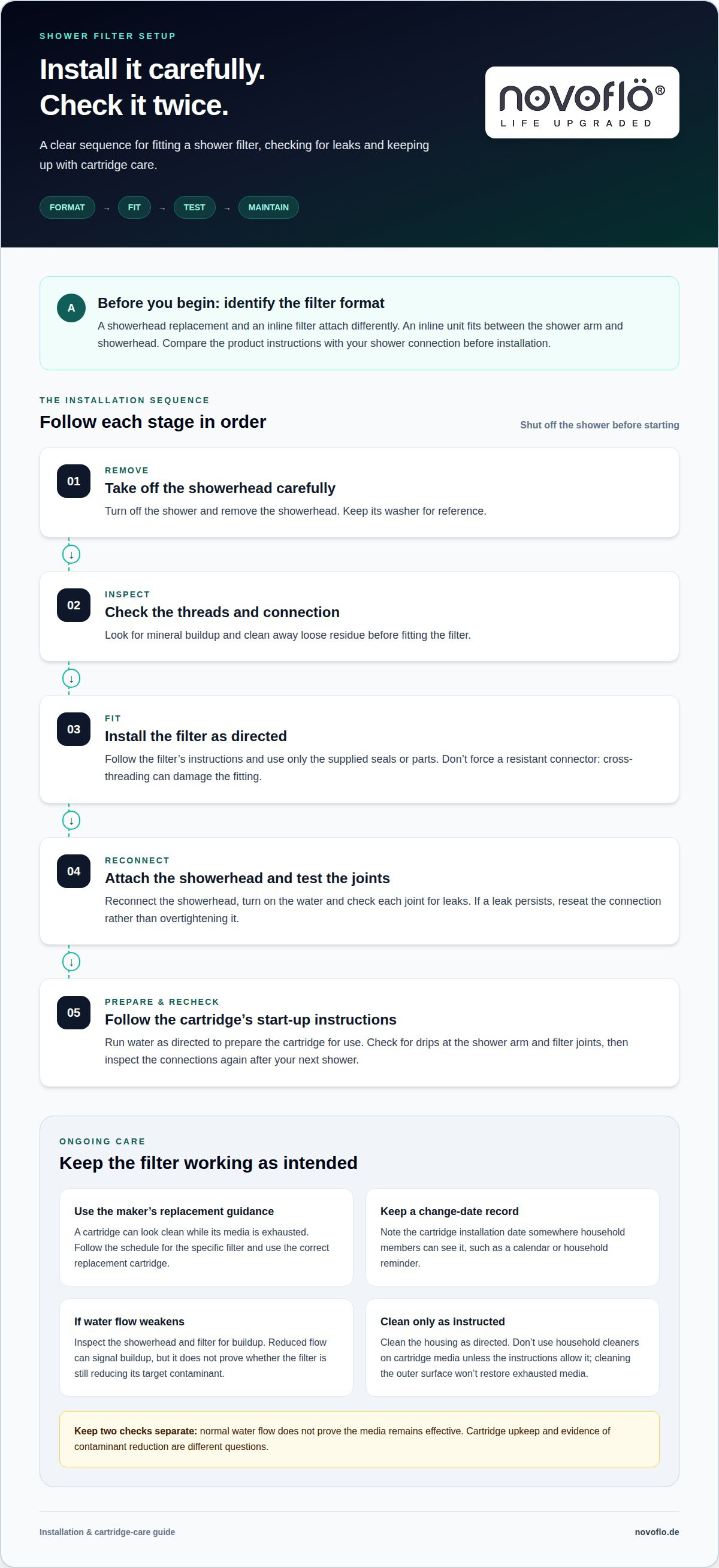
Identify the filter format first: a showerhead replacement and an inline unit attach differently. An inline filter fits between the shower arm and showerhead. Before installation, compare the product instructions with your shower connection. A mismatch can cause leaks or prevent a secure fit.
- Turn off the shower and remove the showerhead carefully, keeping its washer for reference.
- Inspect the threads and connection for mineral buildup, then clean away loose residue.
- Fit the filter according to its instructions, using only the supplied seals or parts.
- Reconnect the showerhead, turn on the water, and check each joint for leaks.
Don’t force a connector that resists turning, since cross-threading can damage the fitting. Follow the filter’s installation guide rather than improvising with extra parts. For example, a filter designed to replace the showerhead won’t necessarily fit as an inline attachment.
After installation, run water as directed in the instructions to prepare the cartridge for use. Check for drips at the shower arm and filter joints, then inspect the connections again after your next shower. If a leak persists, reseat the connection rather than overtightening it.
Cartridge care is central to maintenance. Follow the replacement instructions and clean the housing as directed. If flow weakens, inspect the showerhead and filter for buildup. Don’t use household cleaners on cartridge media unless the instructions allow it. Cleaning the outer surface won’t restore exhausted filtration media.
Keep the installation guide with the filter, and note the cartridge change date where household members can see it. That simple record makes upkeep easier across shared bathrooms. For a domestic shower filtration option, explore shower filtration details alongside the installation and care guidance.
How do I know when to replace the filter?
Use the cartridge maker’s replacement schedule as your baseline, not appearance alone. A shower filter can look clean while its media is exhausted. One published recommendation sets a replacement interval of about every 60 days for a shower filter. Treat that as a product-specific example, not a universal schedule for every cartridge.
Capacity matters. Shower filters contain a limited amount of treatment media, and frequent use can bring a cartridge to the end of its service life sooner. Novoflö recommends replacing its cartridges every three months for families and every four to six months for individuals. Follow the schedule for the specific filter.
- Record the cartridge installation date on a calendar or household reminder.
- Track changes in water flow, since a clogged cartridge can restrict flow.
- Replace the cartridge on schedule, even if the housing still looks clean.
- Use the correct replacement cartridge for the filter body.
Reduced flow can signal buildup, but it doesn’t prove the filter is still reducing its target contaminant. Normal flow doesn’t prove the media remains effective, either. Keep the replacement schedule separate from performance claims: upkeep is one issue, while contaminant reduction requires specific evidence.
How much does a shower filter for heavy metals cost in Egypt? There is no single price across filter types. Cost depends on the product, its stated contaminant claims and replacement-cartridge needs. Compare the full maintenance commitment, not only the initial unit price.
For a practical comparison, work out how often the cartridge needs replacing and how many replacements that means over a year. A lower-priced filter may need more frequent cartridge changes. A longer replacement interval matters only when it matches the manufacturer’s stated capacity and conditions of use.
Replace the cartridge when its stated service life ends. Don’t extend its use just because the water looks clear. Appearance can’t show whether filtration media has reached capacity, and a shower filter marketed for metals needs evidence specific to those metals.
Will a shower filter remove heavy metals?
Don’t assume a shower filter is designed or certified to reduce heavy metals. Assess claims by the specific contaminant and relevant certification, not broad wording on a package.
Heavy-Metal Reduction Claims and Certification
NSF/ANSI 177, the shower-filter standard, covers free chlorine only. It doesn’t establish heavy-metal reduction. A shower filter for heavy metals therefore needs evidence that names the metal and supports the specific reduction claim. NSF/ANSI 53 is the relevant certification to look for when testing confirms heavy-metal contamination. A chlorine claim alone doesn’t answer a metals concern.
Compared with a shower filter, a whole-house system treats water at the home’s entry point, while a point-of-use system treats water at a particular outlet. For confirmed heavy metals, choose a system certified to NSF/ANSI 53 for the contaminant identified. A shower filter is not a substitute for broader treatment when multiple water outlets need addressing.
Checking for Heavy Metals in Shower Water
Testing is the practical first step in Egypt. The Centers for Disease Control and Prevention says water testing can identify harmful chemicals and guide filter choice. Use results that identify the specific metal and its concentration, rather than relying on water appearance, taste, or a general filtration claim. Those signs don’t confirm or rule out heavy metals.
To make the result useful, collect a sample from the shower outlet you’re concerned about and follow the test provider’s sampling instructions. Keep the result tied to that outlet, since a kitchen tap sample may not represent shower water. Then compare the identified metal with a treatment system’s certification and stated contaminant claims.
Choose based on the test result and where treatment is needed. If testing confirms a heavy-metal issue, look for NSF/ANSI 53 certification for that metal; if the concern is free chlorine, NSF/ANSI 177 addresses that narrower target. Don’t treat the two standards as interchangeable.
Novoflö: Novoflö shower filter
Novoflö’s shower filter is designed to reduce chlorine and targeted impurities in everyday shower water. German-engineered for domestic water conditions in Egypt, it supports a shower routine focused on skin and hair care.
Keep the purpose clear: Novoflö’s shower filter is designed to reduce chlorine and targeted impurities, not to replace treatment certified for heavy metals. If testing identifies a metal in your water, choose treatment based on that result and the relevant certification. If your priority is reducing chlorine in your shower water, Novoflö is designed for that need.
Choose according to your water concern, then follow the filter’s installation and cartridge-care instructions. Contact Novoflö to discuss whether its shower filter suits your everyday water-filtration needs.
Choose Your Next Step With Purpose
Make your next water decision specific. Write down what you want to change in your shower routine, and separate that goal from concerns that need a different kind of treatment. This helps prevent expecting one product to solve unrelated problems.
If you’re considering a shower filter for heavy metals, let evidence for the particular metal guide your decision, not confident marketing language. For everyday shower water, consider whether a dedicated filter fits your priorities and the maintenance you’re prepared to keep up with. The right choice matches your concern and your routine.
When you’re ready to explore your options, contact Novoflö about shower filtration. A clear goal makes that conversation more useful and your next step more deliberate. Keep asking what a filter is designed to address. You deserve a choice grounded in your needs, not guesswork.
Frequently Asked Questions
Will a shower filter help with eczema or dry skin?
A shower filter that reduces chlorine may help reduce one potential source of dryness, but it doesn’t treat eczema. Keep skincare and medical-care decisions separate from filtration choices. If skin irritation continues after you change your shower routine, don’t assume water is the only cause. Consider the filter’s specific target and don’t treat a general “skin-friendly” claim as a medical result.
Do shower filters remove heavy metals such as lead, arsenic, and mercury?
Don’t assume a shower filter reduces lead, arsenic or mercury unless the evidence covers each specific metal. Novoflö describes its filter as reducing heavy metals, but that claim alone doesn’t identify which metals or establish a specific certification for them. If testing identifies a metal, match the result to evidence for that contaminant and an appropriate treatment system.
Which shower filter technologies are effective for reducing heavy metals?
No filter media should be treated as effective for every metal without contaminant-specific test evidence. Granular activated carbon combined with KDF 55 is one shower-filtration combination discussed for treatment, but the media names alone don’t prove reduction of lead, arsenic, or mercury. Compare the stated target metals, test conditions, and certification rather than choosing by technology label alone.
What do independent tests and certifications say about shower filter heavy-metal removal?
NSF/ANSI 177 covers free chlorine, not heavy metals. For a confirmed metal concern, look for a system certified to NSF/ANSI 53 for the specific contaminant. A useful test report should identify the product model, target metal, and test conditions. A broad certification claim or chlorine-reduction result doesn’t demonstrate heavy-metal performance.
What are the best shower filters for heavy metals available in Egypt?
Choose based on verified performance for the metal identified in your water, not a broad “best” label. Novoflö’s shower filter is designed for domestic water conditions in Egypt, and its product information describes reduction of heavy metals and other targeted impurities. If a test identifies lead, arsenic or mercury, look for evidence that names that metal before relying on a shower filter for it.
How often should shower filter cartridges be replaced, and what do replacements cost?
Follow the replacement schedule for your specific cartridge. Novoflö states that its cartridges last 3 months for families and 4-6 months for individuals; its 3-pack provides 9 months of filtration. Replacement costs depend on the cartridge pack and coverage period. Compare the cost per cartridge and the months of intended use, rather than judging only by the initial filter purchase.


