


Choose between performance tests and manufacturing certifications
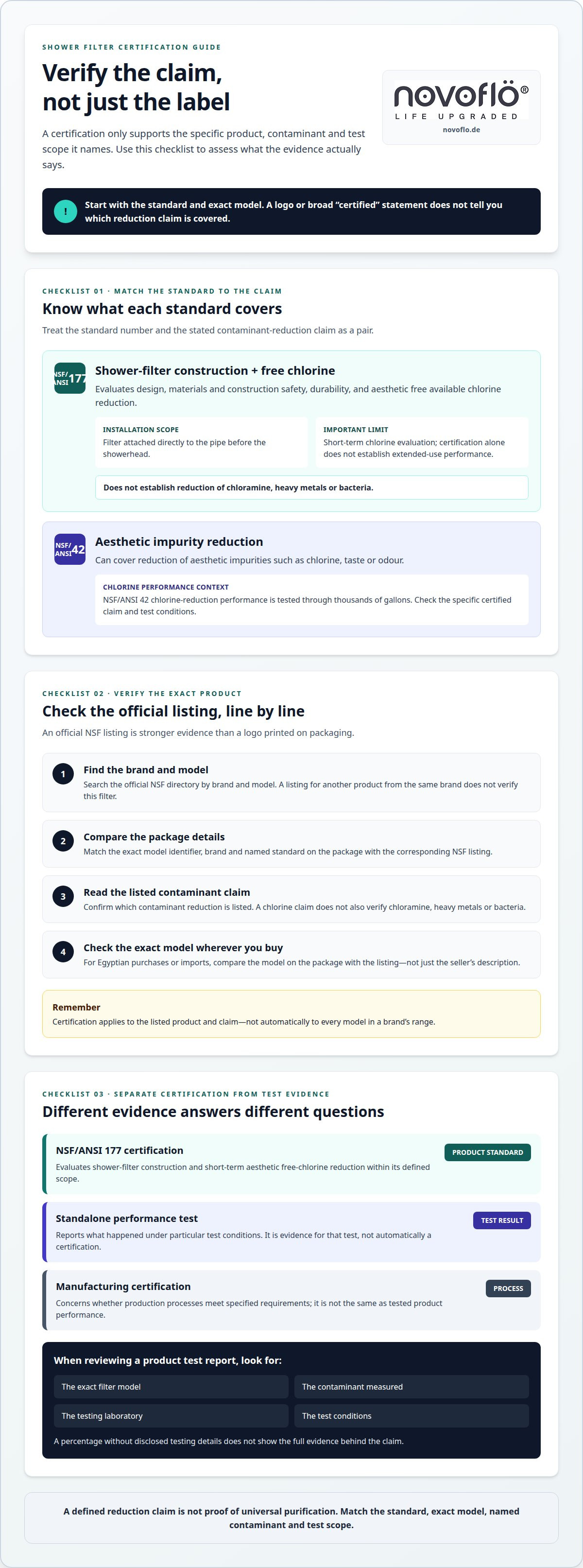
A certification label means little until you know what it covers. To understand how to check shower filter certifications, distinguish NSF/ANSI 177, which evaluates shower-filter construction, safety, durability and aesthetic free-chlorine reduction, from NSF/ANSI 42, which indicates reduction of aesthetic impurities such as chlorine, taste or odour. Neither label alone tells you whether a product has a manufacturing certification or what a separate performance test proves.
It’s sensible to look for evidence before trusting a claim about the water you shower in. The key is matching the standard to the result you care about, then checking that the certification applies to the specific filter and contaminant claim. This guide explains what NSF/ANSI 177 and 42 cover, how to verify certification claims against official listings, and how product-performance tests differ from manufacturing certifications. You’ll also see what test conditions matter, so a bold percentage doesn’t distract from the evidence behind it. For shoppers in Egypt, that distinction makes it easier to assess filtration claims clearly and choose based on what the product is actually validated to do.
Key Takeaways
- Match the standard to the claim: NSF/ANSI 177 focuses on shower-filter construction and free-chlorine reduction, while NSF/ANSI 42 covers aesthetic impurities.
- Use official NSF listings to confirm which specific product and contaminant-reduction claims a certification covers.
- Separate product-performance evidence from manufacturing certifications; test results matter most when the laboratory and test conditions are disclosed.
- Read chlorine-reduction claims in context, including the performance standard and the testing scope behind them.
NSF/ANSI 177 certification for free available chlorine reduction
NSF/ANSI 177 covers shower-filter design, construction safety, durability and aesthetic free available chlorine reduction. A 177 claim does not establish reduction of chloramine, heavy metals or bacteria; it addresses free chlorine.
For shower water, the distinction matters: chlorine reduction is a defined performance claim, not proof that a filter removes every impurity from tap water. Installation also matters because NSF/ANSI 177 applies to filters attached directly to the pipe before the showerhead.
Chlorine-Reduction Claims
A brand’s “chlorine-reducing” statement is useful only when it matches the certified scope. NSF/ANSI 177 identifies aesthetic free chlorine reduction in shower water, alongside evaluation of product design and durability. That differs from a general claim about skin and hair or a broad “purification” label, neither of which identifies a tested contaminant. Treat the standard number and the stated reduction claim as a pair.
NSF/ANSI 177 Requirements
NSF/ANSI 177 evaluates materials and construction safety, product design, durability and reduction of aesthetic free available chlorine. It applies to a shower filter installed directly on the pipe in front of the showerhead. The standard describes a defined scope, not a universal treatment claim. Its chlorine-reduction evaluation is short-term, so certification alone does not establish chlorine performance over extended use.
Use this comparison to understand what each type of evidence can show:
| Evidence | Claim covered | What it tells you |
|---|---|---|
| NSF/ANSI 177 | Aesthetic free chlorine reduction | Shower-filter design, durability and chlorine performance |
| NSF/ANSI 42 | Aesthetic impurities | Can cover chlorine, taste or odour reduction |
| Standalone test result | The tested outcome and conditions | Evidence for that test, not automatically certification |
For a longer-use comparison, NSF/ANSI 42 chlorine-reduction performance is tested through thousands of gallons; NSF/ANSI 177 certification does not itself establish that same long-term scope. Check the specific certified claim and test conditions, rather than treating an initial result as lasting proof. Choose NSF/ANSI 177 when the priority is a shower filter’s defined free-chlorine reduction claim and construction evaluation.
Checking certification claims against official NSF listings
Knowing how to check shower filter certifications starts with matching the exact product model to an official listing. Compare the model, standard and named contaminant claim, whether you are buying in Egypt or importing.
Official NSF Listings
An official NSF listing is stronger evidence than a logo printed on packaging. Search the organization’s directory by brand and model, then confirm the standard and contaminant reduction listed. A listing for another product from the same brand does not establish that the shower filter you are considering is certified. Match the product details exactly before relying on the claim.
Model-Specific Certification Claims
Certification applies to the listed product and claim, not automatically to every model in a brand’s range. Compare the model name on the filter or package with the listing, then check which contaminants it covers. If a listing supports chlorine reduction, do not assume it also covers chloramine, heavy metals or bacteria. Each claim needs its own evidence.
Standards and Packaging Details
Read the packaging for a named standard, certification mark, brand and exact model identifier. Then compare those details with the corresponding NSF listing and its contaminant criteria. A generic “certified” statement doesn’t tell you what the filtration system reduces. For Egyptian purchases, ensure the model details on the package match the listing, not just the seller’s description.
Certified and Uncertified Models
Certification alone does not determine a shower filter’s price. Materials, design, filtration media and replacement needs can also affect cost, so compare those features alongside certification evidence. An uncertified model may make a similar reduction claim, but that is not equivalent to independent certification. To check shower filter certifications effectively, compare the exact model and performance criteria, not price alone.
Distinguishing product-performance tests from manufacturing certifications
NSF/ANSI 177 certification and a laboratory test report answer different questions. The standard evaluates shower-filter construction and short-term chlorine reduction; a performance test reports what happened under particular test conditions.
What does NSF/ANSI 177 certification not guarantee? It doesn’t establish lasting chlorine reduction throughout a cartridge’s use, or reduction of contaminants outside its scope. It also doesn’t make a separate manufacturing certification equivalent to tested product performance.
For a shower filter claiming aesthetic chlorine reduction, product-level evidence should identify the model, contaminant and test conditions. A manufacturing certification, by contrast, concerns whether production processes meet specified requirements. Neither label supports a claim outside its scope, such as drinking-water treatment when the test relates to shower water.
Look for a product performance data sheet or test report. It should link the result to the filter model, name the testing laboratory, describe the test conditions and identify the contaminant measured. A percentage without these details does not show how the result applies to your installation or use.
Laboratory credentials matter. The reported KEWI chlorine test was not KOLAS- or ISO 17025-accredited. That fact doesn’t establish the result is false, but it distinguishes the report’s accreditation status from the result itself. A strict comparison considers both.
- Product test: records a tested performance result under stated conditions.
- Manufacturing certification: addresses production processes, not automatically the performance of a specific filter.
- NSF/ANSI 177: covers structural integrity and short-term chlorine reduction.
Product design and durability matter too. Check that the documentation identifies the model and explains the performance criteria tested. Do not transfer a result from one product to another, even within the same brand. That is the difference between a specific test and a broad claim.
Choose evidence that matches your need: a model-specific performance report for measured results, and a manufacturing certification when assessing production controls. For chlorine reduction, look for NSF/ANSI 177 scope plus disclosed test conditions.
NSF/ANSI 42 certification for aesthetic impurity reduction
NSF/ANSI 42 indicates that a filter reduces aesthetic impurities, including chlorine, taste or odour. For shower filtration, that makes the specific chlorine-reduction claim the key detail, not a broad promise about better water quality.
The standard’s value is its defined performance scope. A filter certified for chlorine reduction has evidence tied to that claim; it doesn’t automatically follow that the same product reduces every contaminant. For example, an NSF/ANSI 42 chlorine claim doesn’t establish reduction of chloramine, heavy metals or bacteria.
Check the exact product model and the contaminant covered in the certification listing. Then compare that claim with the packaging and product information. A mark referring only to NSF/ANSI 42 is less informative than details naming chlorine reduction. Certification should match the model you’re considering, not simply another product from the same brand.
- Chlorine: confirm the listing identifies chlorine reduction.
- Taste or odour: treat these as separate aesthetic claims, not proof of chlorine performance.
- Other contaminants: look for separate evidence; NSF/ANSI 42 alone doesn’t establish their reduction.
NSF/ANSI 42 chlorine-reduction performance is tested through thousands of gallons. That gives the claim a longer-use testing context than a short-term result alone. Still, the certification’s scope matters: it doesn’t prove every filter will perform identically under every household’s water conditions or use.
Don’t confuse aesthetic filtration with drinking-water treatment. NSF/ANSI 42 describes reductions such as chlorine, taste or odour; it isn’t a blanket statement that shower water is suitable for drinking. Likewise, a material-safety claim or another standard shouldn’t be inferred from the 42 mark unless the listing says so.
For an independent check, match the model, standard and stated reduction claim against the listing, then read the test scope. If you’re choosing a shower filter for chlorine reduction in Egypt, explore shower filtration options with the specific claim in mind.
Novoflö: Novoflö shower filter
The Novoflö shower filter is designed to reduce chlorine and targeted impurities in shower water. German-engineered for domestic water conditions in Egypt, it supports healthier skin and hair as part of your everyday routine.
Choose it for shower filtration at the point of use, not as a substitute for whole-house treatment or drinking-water filtration. Keep certification distinctions in mind: a product’s intended filtration benefits and a specific third-party certification are separate claims. Evaluate each using evidence relevant to that claim.
If you want to explore whether the Novoflö shower filter suits your shower routine, contact Novoflö.
Make your next filter choice with confidence
Knowing how to check shower filter certifications gives you a stronger basis for choosing what belongs in your home. Focus on your priority: the specific filtration claim, the evidence behind it and how the product fits your shower routine. A clear claim is more useful than a broad promise.
For households in Egypt, make the next step practical. Decide what you want a shower filter to address, then choose a product based on evidence relevant to that need. If shower filtration is the right fit for your routine, explore the Novoflö shower filter and discuss your needs directly.
Contact Novoflö about shower filters to continue the conversation. A careful choice starts with a clear question, and you’re now better equipped to ask it.
Frequently Asked Questions
What Does “NSF Certified” Mean, and Why Is It Important?
“NSF Certified” means a product has been evaluated against a named NSF standard and within its listed scope. The mark matters only when it connects to the exact filter model and claim you care about. For example, a chlorine-reduction listing does not prove reductions in other contaminants. Check the standard and product details to understand what the certification covers.
What is NSF/ANSI 177?
NSF/ANSI 177 is a standard for shower filtration systems, including aesthetic free available chlorine reduction. It evaluates aspects of the filter’s materials and construction safety, design and durability, as well as chlorine-reduction performance. If a package refers to this standard, focus on the specific product and claim associated with it. The standard is not a blanket claim about every impurity.
Which certifications are relevant for shower filters, such as NSF/ANSI 177?
NSF/ANSI 177 is relevant to shower filters claiming aesthetic free-chlorine reduction. NSF/ANSI 42 covers aesthetic impurity reduction, including chlorine, taste or odour. Choose based on the stated purpose: a household focused on chlorine should look for a certification scope that names chlorine reduction. Other marks may address different criteria, so their relevance depends on the exact claim they support.
How can I verify a shower filter certification in the NSF certified products database?
Search the NSF certified products database using the brand and exact model name on the package. Open the matching entry and compare its standard and listed contaminant claim with the product description. If the listing names chlorine reduction, do not treat it as confirmation of bacteria reduction. Similar branding alone is not enough: confirm the model.
How do I check whether a shower filter is certified by WQA or another accredited body?
Use the certifying organization’s official directory and search for the filter’s exact brand and model. Confirm the listed standard, certification scope and contaminant claim, then compare these details with the packaging. For a WQA mark, look for a matching WQA record. If another organization is named, check its own records rather than relying only on the seller’s product wording.
What does NSF/ANSI 177 test and what contaminants does it cover?
NSF/ANSI 177 evaluates shower-filter materials and construction safety, product design and durability, alongside short-term reduction of aesthetic free available chlorine. Its contaminant scope is specific: it doesn’t establish reduction of chloramine, heavy metals or bacteria. For example, a 177 chlorine claim supports that stated reduction scope, not a general promise to remove every impurity from shower water.


