


Choose a certified shower filter by verification and capacity
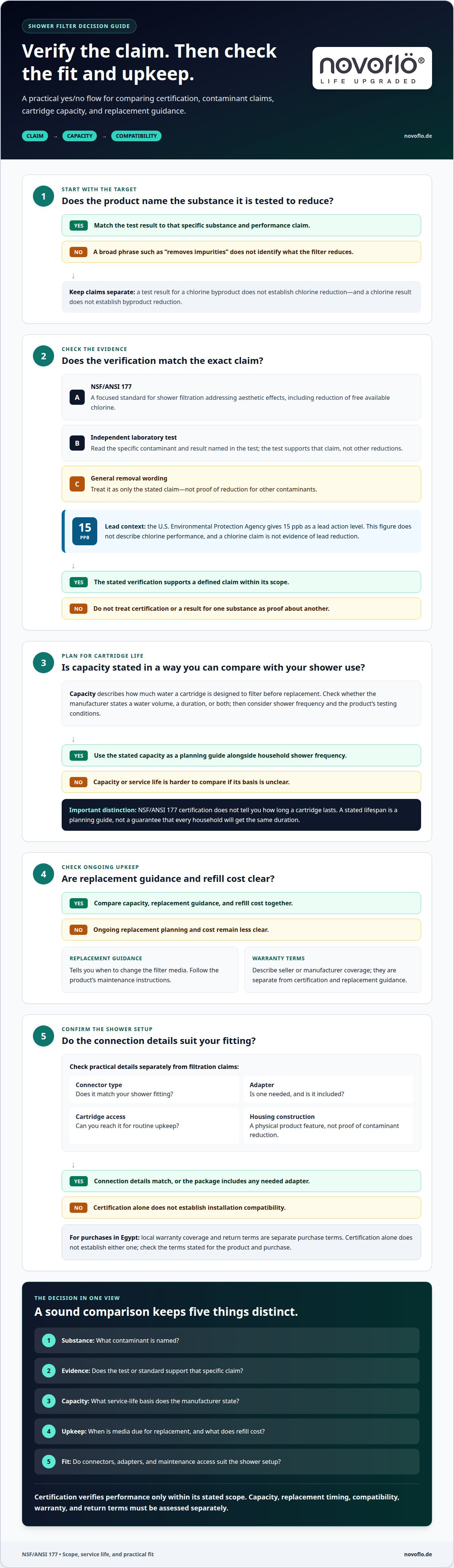
NSF/ANSI 177 is the standard for shower filtration systems that address aesthetic effects, including reducing free available chlorine. A certified shower filter has been evaluated against that standard’s scope, not every possible water contaminant. Certification tells you what the filter is designed to reduce; it doesn’t tell you how long a cartridge lasts.
A certification mark is a starting point, not the whole decision. Capacity and replacement intervals matter too, especially when you want a filter that fits your household’s shower routine. This guide explains what NSF/ANSI 177 verifies, how to compare certification and capacity across models, and what replacement guidance can tell you about ongoing use. You’ll be able to distinguish a meaningful verification claim from a broad promise, then weigh the practical differences that shape your choice in Egypt. Clear criteria make the comparison simpler: know what the standard covers, match capacity to your needs, and understand when the filter media is due for replacement.
Key Takeaways
- Learn what NSF/ANSI 177 covers, and why certification applies to specific performance claims rather than every possible impurity.
- Understand how the U.S. Environmental Protection Agency’s 15 ppb lead action level fits into product verification.
- Compare filter capacity and replacement intervals by considering how usage and cartridge limits affect upkeep.
- Use a practical model comparison to weigh verification, capacity, and replacement needs, then see where the Novoflö shower filter fits.
Why work with NSF for shower filter certification?
NSF/ANSI 177 sets a defined benchmark for shower filtration and aesthetic effects. Compare its scope with specific testing and product claims.
Independent Testing for Chlorine Byproducts
Independent laboratory testing assesses a defined substance under stated conditions. For chlorine byproducts, check exactly what the test measures: a result for a byproduct does not establish chlorine reduction, and vice versa. Treat each result as a separate claim. Test evidence is useful only when it identifies the contaminant and the performance evaluated.
NSF/ANSI 177 Certification and Chlorine Reduction
NSF/ANSI 177 is the standard for shower filtration systems addressing aesthetic effects, including reduction of free available chlorine. That makes it a focused reference for chlorine-related filtration claims, rather than proof of broad contaminant removal. A certified shower filter should be understood within that scope. Certification helps distinguish a defined performance category from general wording about cleaner or better-feeling water.
Free Available Chlorine Reduction Claims
A free available chlorine reduction claim concerns chlorine in its available form, not every substance that may be present in shower water. Read the claim beside its testing or certification basis. The U.S. Environmental Protection Agency gives an action level of 15 ppb for lead, but that figure does not describe chlorine performance. Keep each contaminant and its evidence separate.
Chlorine Removal and Other Contaminants
“Chlorine removal” can sound broader than a documented reduction claim. NSF/ANSI 177 addresses aesthetic effects, including free available chlorine reduction; it does not, by itself, establish reduction of every other contaminant. For example, a chlorine claim cannot also serve as evidence for lead or chlorine byproducts. Match each named substance to its own test result or applicable certification.
| Option | What it addresses | How to interpret it |
|---|---|---|
| NSF/ANSI 177 | Aesthetic effects, including free available chlorine reduction | Focused standard scope |
| Independent laboratory test | The contaminant named in the test | Read the specific result |
| General removal claim | Only the stated claim | Not proof of other reductions |
Choose a filter whose documented performance matches the contaminant you want to reduce.
Consumer trust and product verification
In Egypt, a filter is compatible when its connectors match the shower fitting, with any needed adapter included. Certification identifies tested performance, not thread size or installation fit. A certified shower filter label therefore can’t establish compatibility by itself; compare the product’s connection details with your fitting before choosing.
With an uncertified filter, the main concern is relying on reduction claims without clear evidence for the named contaminants. Poor maintenance can also affect performance when the filter media reaches its replacement point. Certification does not make a filter risk-free or prove performance beyond its stated scope. Follow the product’s maintenance instructions.
Separate product evidence from broad marketing language. Look for the certification standard and specific performance claim, then note which substance was tested. A promise such as “removes impurities” does not identify what the product reduces. Your shower routine alone cannot show whether a filter’s tested capacity or replacement interval suits your use. For a certified shower filter, match each claim to its supporting evidence.
Maintenance and warranties answer different questions. Replacement guidance tells you when to change filter media; warranty terms describe the seller’s or manufacturer’s coverage. Neither follows automatically from certification. For returns, the applicable policy is the one published for that purchase. Keep product instructions and proof of purchase together, so you can follow maintenance steps and refer to the relevant terms.
Check installation details separately from filtration claims. Connector type, adapter requirements, cartridge access, and housing construction affect fit and routine upkeep. A well-designed product can make cartridge changes straightforward, while durable construction concerns the physical housing. These features do not demonstrate contaminant reduction. Compare them as practical criteria, not substitutes for tested performance.
Certified shower filters are available through sellers serving Egypt, but local warranty coverage is a separate purchase term. Certification alone doesn’t establish a local warranty or return policy. Read the product’s stated coverage and returns terms before purchase. Choose a certified shower filter whose connection details and maintenance instructions suit your shower setup.
Choose a certified filter whose connector matches your shower fitting, or whose package includes any adapter needed for the connection. Certification alone does not establish compatibility.
Filter capacity and replacement intervals
Capacity links the filter’s stated service life to replacement planning, not simply to its certification. Compare the manufacturer’s capacity, replacement guidance, and refill cost together.
Filter Capacity
Capacity describes how much water a cartridge is designed to filter before replacement. It differs from NSF/ANSI 177 certification, which concerns performance claims within its standard scope, not a universal cartridge lifespan. Check whether capacity is stated as a water volume, a duration, or both. Then compare the stated basis with your household’s shower frequency and the product’s testing conditions.
A cartridge’s stated lifespan is a planning guide, not a guarantee that every household will use it for the same length of time. Novoflö recommends replacement every three months for families and every four to six months for individuals. Use that guidance to plan changes according to your household’s routine.
Replacement Schedules and Service Cycles
A replacement schedule tells you when to install a fresh cartridge; a service cycle is the period between changes. These are different from capacity, which may depend on the volume of water filtered. Follow the product’s replacement instructions and record the installation date. This makes the next change easier to plan.
Replacement matters for continued performance. Follow the recommended service period rather than assuming an older cartridge still meets the product’s filtration claims. Shower filters are not substitutes for drinking-water treatment; use the appropriate product for each purpose.
Upfront and Replacement-Filter Costs
Compare the upfront price with the cost of replacement cartridges in EGP. A lower initial price may not mean lower long-term expense if refills cost more. Conversely, a higher price does not establish that a filter costs less to maintain. Use the stated cartridge schedule to estimate how often replacements will enter your household budget.
For a practical comparison, divide a refill’s price by the service period it is intended to cover. Compare products only when their stated replacement intervals use similar conditions. Keep filtration claims separate from cost: testing and certification describe performance evidence, while price describes what you pay to maintain the filter.
Shower filter brands and models
Compare specific models by the evidence attached to their claims, not by brand recognition alone. For Egypt’s municipal water context, start with the substance addressed, certification scope, and cartridge capacity. NSF/ANSI 177 covers aesthetic effects, including free available chlorine reduction. A certified shower filter should be assessed against its stated scope, not assumed to treat drinking water or every contaminant.
Use this comparison sequence across models:
- Certification: Identify the named standard and the model it applies to.
- Claim scope: Separate free available chlorine claims from claims about other substances.
- Component information: NSF/ANSI/CAN 372 covers lead content in drinking water system components. A [Pb] mark relates to lead content, not chlorine reduction.
- Practical fit: Compare connector details, cartridge capacity, replacement guidance, and refill availability in Egypt.
These criteria help you compare products without treating one certification mark as proof of every feature. A documented chlorine-reduction claim answers a different question from information about a product’s construction. Compare a certified shower filter on its specific performance claims, and assess component marks and maintenance details separately.
Build a shortlist by recording each model name, standard or marking, stated contaminant claim, capacity, and replacement guidance. Then compare the entries side by side. If two models address the same priority, cartridge lifespan and replacement planning can help you judge their practical fit. Do not treat drinking-water component information as evidence of shower filtration performance.
Choose the model whose documented scope and maintenance needs align with your priorities. Explore shower filtration options using these comparison criteria.
Novoflö: Novoflö shower filter
Novoflö’s German-engineered shower filter is designed for domestic water conditions in Egypt and reduces chlorine and targeted impurities in shower water. It focuses on your daily shower, not drinking water or whole-house treatment.
Use the comparison criteria in this guide to decide what matters most: the scope of the claim, cartridge lifespan, replacement schedule, and fit with your routine. Choose a personal shower filter when it suits your needs, rather than when you need a different type of water treatment. Keep expectations clear by matching filtration claims to the product’s stated performance.
For information about the Novoflö shower filter, contact Novoflö.
Make your next shower choice deliberate
Your next step is to turn comparison into a choice that fits your home. A certified shower filter is most useful when its documented purpose, upkeep, and everyday role match what you actually need. Keep that standard in view as you decide. Clear priorities help cut through broad claims and focus attention on a product that belongs in your routine.
Novoflö offers the Novoflö shower filter for people considering a personal shower filtration option. If you’re ready to explore whether it suits your needs, contact Novoflö about shower filters. Bring your priorities into the conversation and take the next step with confidence.
Frequently Asked Questions
What is NSF/ANSI 177?
NSF/ANSI 177 is a standard for shower filtration systems addressing aesthetic effects, including free available chlorine reduction. Its scope helps clarify what a chlorine-related performance claim covers. For example, a filter evaluated for chlorine reduction hasn’t thereby demonstrated reduction of lead, microbes, or every other substance. Match the standard’s scope to the specific performance you want to compare.
What does certification mean for a shower filter, and which standards apply?
Certification connects a named product or claim to a defined standard or evaluation. For shower filtration, NSF/ANSI 177 addresses aesthetic effects, including free available chlorine reduction. A certified shower filter should be considered within the scope of its stated certification, rather than as proof of broad contaminant removal. Other marks may address different product or component criteria, so distinguish their purposes.
Which shower filters are certified by NSF/ANSI or other recognized organizations?
Certification applies to specific products and claims, so a brand name alone doesn’t establish which model or performance is covered. Novoflö lists NSF, CE, RoHS, SGS, and ISO certifications for its filtration system. Those names shouldn’t be treated as interchangeable standards. For a model comparison, distinguish a listed certification from evidence that a particular chlorine-reduction claim falls under NSF/ANSI 177.
What contaminants can a certified shower filter remove or reduce?
The substances a filter reduces depend on its stated claims and testing. Novoflö says its shower filter reduces chlorine and targeted impurities, including heavy metals, VOCs, microplastics, bacteria, rust, and sediment. A listed substance does not mean the filter removes every contaminant or treats drinking water. Compare each named substance with the product’s stated filtration purpose before deciding.
How can I verify a shower filter’s certification and test results?
Start with the exact model name and match it to the certification and stated claim. For a certified shower filter, check that the named standard relates to the performance being described rather than relying on a general certification label. Read the test results for the substance tested and the reported result. Keep the model, claim, standard, and evidence connected when comparing products.
How much do certified shower filters and replacement cartridges cost in Egypt?
These are Novoflö product prices, not a market-wide average. Compare the included cartridges and replacement schedule as well as the upfront cost when planning your purchase.


