


Shower filtration system choices for chlorine reduction and water flow
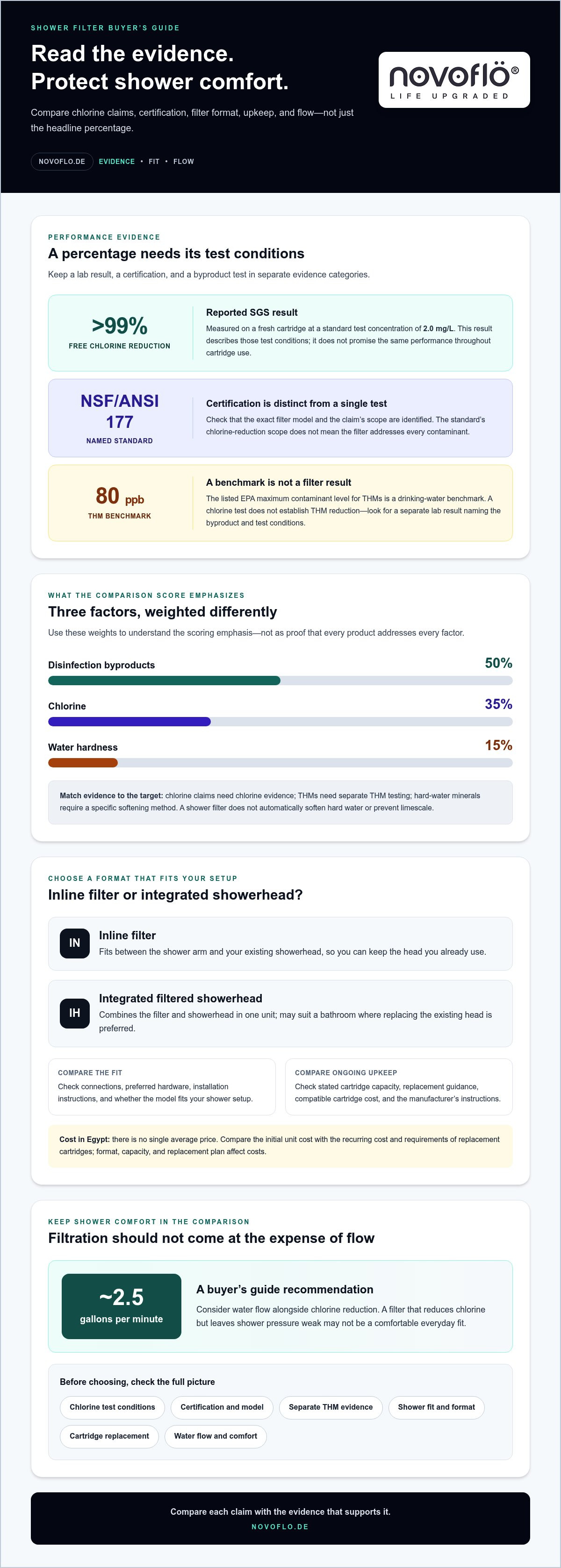
A filter that cuts chlorine but leaves the shower pressure weak is only half a solution. Choose a shower filtration system by comparing chlorine-reduction evidence, certification, installation fit, cartridge upkeep, and water flow; a buyer’s guide recommends a flow rate typically around 2.5 gallons per minute. The best fit is the one that addresses your priorities without making daily showering less comfortable.
You’re right to look beyond a product’s headline claims. What matters is how performance is demonstrated, whether the filter fits your shower, and what maintenance it requires. A chlorine-reduction claim alone does not show whether performance has been independently tested or how the filter may affect water flow.
This guide explains how to compare filter types, understand certification claims, and assess installation and cartridge replacement. It also offers a practical way to weigh chlorine reduction against water flow, so you can choose a setup that suits your bathroom in Egypt.
Key Takeaways
- Compare chlorine-reduction claims with the certification and test details behind them, not just the headline.
- Choose between an inline filter and an integrated showerhead by weighing your existing setup against the format you prefer.
- Plan for cartridge upkeep by understanding how replacement affects the filter’s ongoing performance.
- Protect shower comfort by considering flow rate alongside filtration; a buyer’s guide recommends around 2.5 gallons per minute.
Chlorine reduction and NSF/ANSI 177 certification
Compare the reduction claim, its test conditions, and certification separately. A reported result above 99% applies to free chlorine on a fresh cartridge at a standard test concentration of 2.0 mg/L.
Chlorine Reduction Claims
A chlorine-reduction result describes measured performance under stated test conditions. The reported SGS result, above 99% free chlorine reduction, applies to a fresh cartridge tested at 2.0 mg/L. That detail matters: it identifies both the starting concentration and cartridge condition, rather than promising the same result throughout the cartridge’s use.
Compare claims by checking which contaminant was tested, the test concentration, and whether the test used a fresh cartridge. A percentage without those details is less informative than a result tied to a defined test. Evidence of chlorine reduction does not, by itself, establish performance against THMs or other chlorine byproducts.
NSF/ANSI 177 Certification
NSF/ANSI 177 is the certification standard referenced for shower-filter chlorine reduction. Certification provides a different kind of evidence from a single reported lab result: it identifies performance assessed against a named standard. A result from one test and certification to a standard are not interchangeable claims.
For a useful comparison, look for the exact standard number, NSF/ANSI 177, and whether the claim concerns the specific filter model. Then distinguish the standard’s chlorine-reduction scope from any broader suggestion that a filter addresses every water contaminant. The SGS result above 99% is a test result; the standard is a separate certification criterion.
THM and Chlorine-Byproduct Lab Results
Chlorine reduction does not automatically show how a filter performs against trihalomethanes, or THMs. Look for a separate lab result naming the byproduct tested, the test conditions, and the measured change. The listed EPA maximum contaminant level for THMs is 80 ppb, a drinking-water benchmark rather than a shower-filter result.
Keep the evidence categories distinct. A chlorine test supports a chlorine claim; a THM result must address THMs directly. A benchmark of 80 ppb does not prove a shower filter reduces THMs, and a chlorine percentage cannot substitute for byproduct testing.
| Evidence option | What it shows | Key comparison point |
|---|---|---|
| Fresh-cartridge test | Measured free chlorine reduction | Over 99% at 2.0 mg/L |
| NSF/ANSI 177 | Assessment against a named standard | Check the model and claim scope |
| THM lab result | Testing directed at chlorine byproducts | Look for a separate THM measurement |
Choose by matching each claim to its evidence: chlorine test, standard certification, and separate THM results.
Inline filters versus integrated showerheads
Inline models fit between the shower arm and showerhead; integrated models combine the filter and showerhead in one unit. Choose based on the contaminant you want to address, your preferred hardware, and the upkeep you can manage.
For chlorine, choose a filter with evidence of chlorine reduction. Sediment requires a filter designed for particles, while hard-water minerals require a specific softening method. A shower filter does not automatically soften hard water or prevent limescale.
There is no single average price for shower filters in Egypt. Costs depend on the format, cartridge capacity, and replacement plan. Compare the initial unit cost with the recurring cost and requirements of replacement cartridges.
Options in Egypt include inline filters, integrated filtered showerheads, and the Novoflö shower filter, available through Novoflö’s online store.
Use a shower filter according to its instructions and replace cartridges as directed. Stop using the unit if it leaks or becomes damaged. Maintenance needs and contaminant claims vary by model.
Inline Shower Filters
An inline filter attaches between the existing shower arm and showerhead, letting you keep your current showerhead. This separates filtration from spray design. An integrated model combines the filter and showerhead, which can suit bathrooms where replacing the existing head is preferred.
For comparison, the testing score weights disinfection byproducts at 50%, chlorine at 35%, and water hardness at 15%. Use those criteria to identify what the scoring emphasizes, then match them to the contaminants named in a filter’s evidence. The score doesn’t establish that every product addresses all three.
Capacity and Replacement Costs
Cartridge capacity affects replacement frequency, while water use and filter design determine how quickly that capacity is reached. Compare each model’s stated capacity and replacement guidance instead of assuming inline and integrated filters follow the same schedule.
Include replacement cartridges in your cost comparison. A lower initial price may not mean lower ongoing costs if replacements are needed more often. In Egypt, compare the unit with its compatible replacement cartridge, then follow the manufacturer’s instructions to maintain the intended filtration performance.
Both formats can target specific contaminants, but neither is a universal fix. Choose based on evidence, fit, and cartridge maintenance, not appearance alone.
Installation and cartridge maintenance
A secure fit and timely cartridge replacement support consistent filtration. Follow the instructions for your specific shower filter, because connections and cartridge designs vary.
Prepare and Install the Filter
Before fitting an inline unit, compare its connections with your shower arm and showerhead. Remove the existing showerhead only as the filter instructions direct. Keep the original parts nearby in case you need to restore the setup.
Check that the supplied gasket sits flat inside the connection. Attach each part in the specified order, then turn on the water and inspect every joint for leaks. If water escapes around a connection, turn it off and reseat the gasket before using the shower.
An integrated filtered showerhead may replace the existing head, while an inline filter fits between the arm and head. That difference determines which parts you remove and reconnect. Follow the instructions for your chosen format rather than using the same installation method for both.
Replace and Maintain Cartridges
Cartridge lifespan depends on its rated capacity, household shower use, and incoming water conditions. Follow the manufacturer’s replacement schedule and capacity guidance. A cartridge used by several people may reach its limit sooner than one used for a single daily shower.
Record the replacement date near the bathroom or in a household calendar. When changing a cartridge, use the compatible replacement and follow its fitting instructions. A cartridge that is not seated correctly can let water bypass the filter.
After replacement, run water as instructed and inspect the connections again. Note any leaks, unusual changes in flow, or visible cartridge damage, then follow the product instructions before continuing use. Don’t extend cartridge use just because the outer casing looks clean: the filtration media is inside, and appearance alone cannot show its remaining capacity.
For predictable maintenance, record the installation date, track household shower use, and replace the cartridge according to its specified guidance. These steps help you plan upkeep without assuming every filter has the same lifespan.
Water flow and shower pressure
Filtration shouldn’t leave the shower feeling weak. A buyer’s guide recommends a suitable flow rate typically around 2.5 gallons per minute. Treat that as a comparison point, then consider your home’s existing pressure and the shower experience you want.
Flow rate and pressure are related but different. Flow rate measures how much water passes through the showerhead over time; pressure is the force pushing water through the plumbing and filter. A filter can affect the flow you experience, while low incoming pressure can also make a shower feel weak.
Compare the shower before and after fitting a filter. Keep the same showerhead setting, collect water in a marked container, and time the collection. Convert the amount collected to gallons per minute, then compare the result with the guide’s 2.5-gallon-per-minute reference. Repeat the test under similar conditions for a useful comparison.
If flow drops after installation, inspect the setup before blaming the filter. Check for a kinked hose, a poorly seated gasket, or debris at a connection. Review the cartridge’s replacement guidance, since it may need changing if it has reached capacity. Compare the flow before and after replacement to see whether it changes.
- Weak flow before installation: check the shower’s baseline output and existing plumbing conditions.
- Weak flow after installation: inspect connections, hose position, and cartridge condition.
- Different showerhead settings: compare the same setting each time, because spray patterns can feel different.
Choose a model with a stated flow rate and weigh filtration evidence against the pressure you need for comfortable daily use. The 2.5-gallon-per-minute reference helps frame the comparison, but your baseline shower output matters too.
Explore shower filtration options and compare filtration with the flow your bathroom needs.
Novoflö: Novoflö shower filter
The Novoflö shower filter is a practical option if you want to reduce chlorine and targeted impurities in shower water. German-engineered for domestic water conditions in Egypt, it brings filtration into an everyday routine focused on skin and hair.
Choose it when you want personal shower filtration rather than whole-house treatment or water softening. Compare its filtration claims with your needs, then consider the showerhead connection and cartridge maintenance before installation. Keep the fitting and replacement instructions close at hand to make upkeep part of your routine.
Ready to explore the Novoflö shower filter? Visit Novoflö online to learn more.
Make your next shower choice deliberate
Start by deciding what matters most in your daily routine. If chlorine reduction is the priority, focus on the evidence behind that claim. If shower comfort comes first, consider how filtration fits your existing setup and water flow. The right shower filtration system should suit the way you use your shower, not just look convincing on a product page.
Keep the decision practical: consider who uses the shower, how you’ll maintain the cartridge, and whether the filter’s purpose matches your needs. Novoflö offers its shower filter for people looking to reduce chlorine and targeted impurities in shower water. It is a focused option for personal shower filtration, not a substitute for whole-house treatment or water softening.
Ready to explore whether it fits your routine? Contact Novoflö about shower filtration. Make your next choice with clarity, and build a better-informed daily routine.
Frequently Asked Questions
What does a shower filtration system remove from water?
A shower filter reduces only the contaminants its media is designed and tested to address. Novoflö’s shower filter is intended to reduce chlorine and targeted impurities. Don’t assume a chlorine claim also covers sediment, lead, THMs, or hardness minerals. If limescale is your main concern, check whether the filter specifically addresses hardness; chlorine reduction alone does not establish that.
How effective are shower filters, and what certifications should I look for?
Effectiveness depends on the specific contaminant, test conditions, and evidence for the model. Look for a clearly scoped claim and NSF/ANSI 177 certification when evaluating chlorine reduction. A certification is not proof that a filter removes every contaminant. For example, a chlorine claim doesn’t establish THM reduction; that requires separate testing directed at THMs. Match the evidence to your water concern.
How much do replacement shower filter cartridges cost in Egypt, and how often should they be changed?
The product listing describes the pack as providing nine months of use. Follow the cartridge replacement instructions and account for household shower use. For other filters, don’t assume the same interval applies: capacity and replacement guidance vary by product.
How do I install a shower filter on a standard shower in Egypt?
For an inline filter, follow the supplied instructions for connecting it between the shower arm and showerhead. Turn off the water before removing parts, keep the gasket seated correctly, and tighten connections as directed. Turn the water on and check for leaks before showering. In an Egyptian bathroom, connection fit depends on the existing shower hardware, so use the filter’s instructions rather than forcing a mismatched fitting.
Can shower filters reduce water pressure or affect shower temperature?
A filter can affect the flow you feel at the showerhead, especially if water meets a restriction or the cartridge needs replacing. The shower’s hot-and-cold water supply controls temperature, not the filter itself. If the shower feels weaker after fitting a filter, check for a kinked hose, blocked connection, or cartridge issue, then compare flow at the same shower setting.
Which shower filter types work best for chlorine, sediment, and hard water?
For chlorine, choose a filter with evidence of chlorine reduction. For sediment, choose one designed for particles. For hard water, choose a filter with a specific softening method.


