


Shower filter bacteria claims: What filters can remove
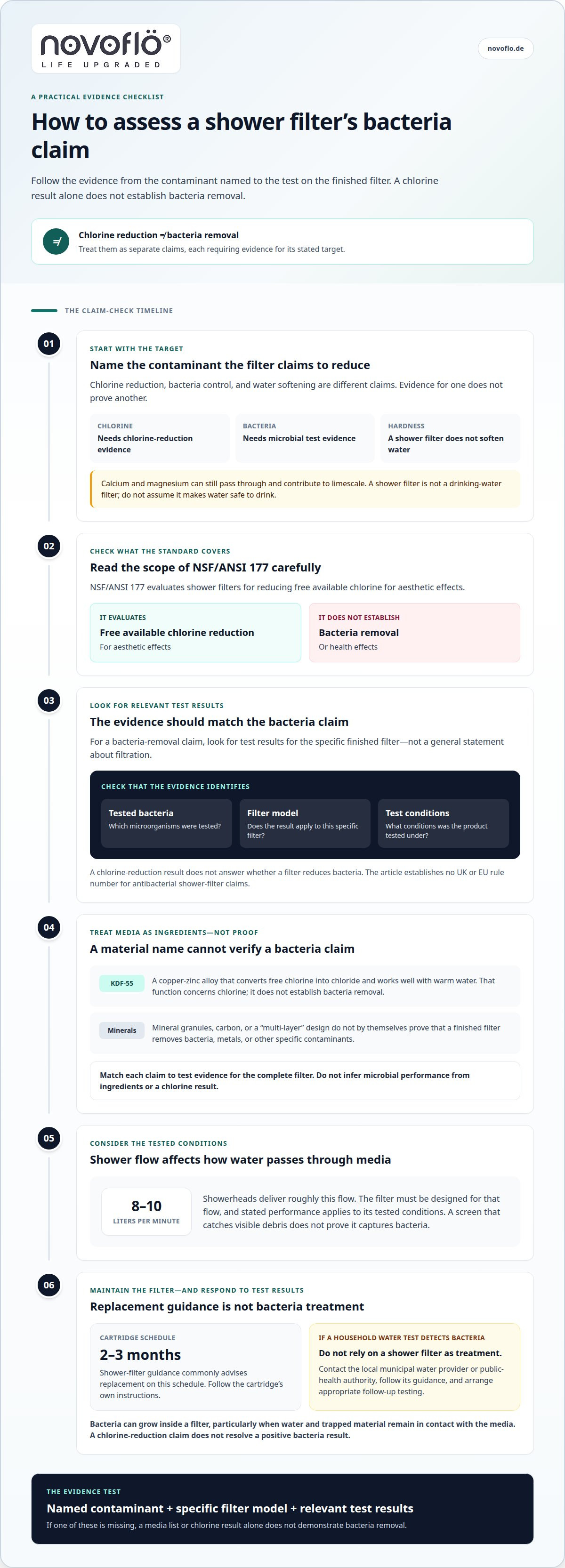
A shower filter’s chlorine reduction does not prove it removes bacteria. The shower filter bacteria claims that matter are backed by evidence of microbial reduction, not just a promise to reduce chlorine. NSF/ANSI 177 evaluates shower filters for reducing free available chlorine for aesthetic effects, not health effects.
It’s reasonable to pay attention to water that passes through your shower hose. But a filter’s media and test results determine what it can actually reduce. KDF-55 and mineral granules work differently, and neither should be treated as proof of bacteria removal without relevant evidence.
This guide explains what shower filters can remove, how KDF-55 and mineral granules work, and how to assess bacteria claims when choosing a filter in Egypt. You’ll learn why chlorine reduction and bacteria removal are separate claims, what a filtration standard does and doesn’t establish, and which questions help you judge whether a filter matches your concern.
Key Takeaways
- Separate chlorine-reduction claims from bacteria-removal claims; evidence for one doesn’t establish the other.
- Learn what KDF-55 does to free chlorine and why filter media alone doesn’t prove a product removes microbes.
- Understand why a shower filter won’t soften hard water or stop limescale from passing through.
- Use the filter’s specific target contaminants and relevant test evidence to assess whether its claims match your concern.
Claims about removing bacteria and other contaminants
A shower filter can reduce specific impurities, but its filtration media and supporting evidence determine what it can remove. Chlorine reduction, bacteria control, and water softening are separate claims.
Removal Claims and Limitations
A removal claim names a contaminant the filter is designed and tested to reduce. This distinction matters: a filter that reduces chlorine does not automatically remove bacteria, lead, or other impurities.
NSF/ANSI 177 evaluates reduction of free available chlorine for aesthetic effects, not health effects or bacteria removal. Shower filters also don’t lower hardness, so calcium and magnesium can still pass through and contribute to limescale. And a shower filter is not the same as a drinking water filter: don’t assume it makes water safe to drink.
Verification of Bacteria Claims
To verify a bacteria claim, look for test results for the specific filter. This helps distinguish evidence of microbial reduction from broad marketing language.
NSF/ANSI 177 is a shower-filtration standard, but it assesses free available chlorine reduction, not bacteria removal. The supplied facts establish no UK or EU rule number for antibacterial shower-filter claims. For a claim sold in those markets, look for evidence that identifies the tested bacteria, the filter model, and the test conditions; a chlorine-reduction result alone doesn’t answer that question.
Technologies Tested for Bacteria Removal
A bacteria-removal claim should be based on testing the finished filter against named microorganisms, not inferred from its ingredients. Different filtration media target different contaminants.
KDF-55 is a copper-zinc alloy that converts free chlorine into chloride and works well with warm water. That function does not establish bacteria removal. The facts here identify no bacteria-removal test for KDF-55, mineral granules, or another shower-filter technology. Judge the claim by product-specific microbial test evidence, not by the media name or a chlorine result.
Cartridge Replacement and Detected Bacteria
Replacement means changing filter media on the maker’s stated schedule, which helps maintain its intended performance. Shower-filter guidance commonly advises replacing cartridges every 2 to 3 months; follow the cartridge’s own instructions.
Bacteria can grow inside a filter, particularly when water and trapped material remain in contact with the media. If a household water test detects bacteria, do not rely on a shower filter as treatment. Contact the local municipal water provider or public-health authority, follow its guidance, and arrange appropriate follow-up testing. A chlorine-reduction claim does not resolve a positive bacteria result.
Filter media, including KDF-55 and mineral granules
Filter media are the materials water passes through, and different types have different targets. A list of ingredients alone does not show which contaminants the finished filter reduces.
Filtration media and their targets
Carbon media can capture some compounds as water passes across their surface. Mineral granules are another type of media, but the name alone does not show what they remove. Look for a clear link between the named material, the specific contaminant, and test evidence for the complete filter.
Claims about metals or heavy metals also need precision. Saying a filter uses “multi-layer filtration” does not establish that it reduces lead or other metals. Each layer may serve a different purpose, so assess the stated target and supporting evidence for each claim.
KDF filter media
KDF-55 is a copper-zinc alloy that converts free chlorine into chloride and works well with warm water. Its stated function concerns chlorine, not bacteria, hardness, or every metal. KDF-55 media is identified as certified by the National Science Foundation for chlorine removal; that does not mean every filter containing it has been tested for every claim.
For example, a shower filter combining KDF-55 with carbon may use both media for different targets. Don’t treat the combination as proof of broad contaminant removal. Check which contaminants the finished filter is tested to reduce, and distinguish those results from claims based only on a media ingredient.
Mineral granules also need product-specific evidence. Their presence doesn’t establish antibacterial performance or a change in water hardness. In Egypt, match the filter’s stated targets to your concern, such as chlorine reduction, rather than assuming the media removes all impurities. For a chlorine-focused option designed for domestic water conditions in Egypt, explore the Novoflö shower filter.
How shower filters work
A shower filter sits in the water path, so water passes through its internal media before reaching the shower head. The media and the time water spends passing through them help determine which contaminants may be reduced. A screen can catch larger particles, while treatment media act on specific substances. These mechanisms are not interchangeable, and a filter’s targets depend on its design.
Flow matters. Showerheads deliver roughly 8 to 10 liters per minute, so water moves through a shower filter quickly. The filter must be designed for that flow, and its stated performance applies to its tested conditions. A layer that targets one substance doesn’t automatically capture dissolved contaminants or alter every property of the water.
Shower filter bacteria claims should explain how the filter addresses microbes, not just list its materials. A screen that catches visible debris does not prove it captures bacteria. Assess test evidence for the finished filter and the specific microbial claim. Do not assume that contact with filtration media means bacteria are removed or inactivated.
Hardness is a clear example of a separate water property. Calcium and magnesium minerals remain unless a suitable softening process removes them. A shower filter doesn’t work like a water softener, so it won’t stop hardness minerals passing through and settling on bathroom surfaces. Under the stated assumptions, a shower running at 8 liters per minute for 8 minutes passes about 9 grams of limescale through the showerhead.
Mineral deposits can build up on a shower head and affect its spray pattern. Cleaning removes deposits from surfaces, but it does not change the hardness of incoming tap water. Guidance advises cleaning the filter screen every month to clear collected debris and maintain water flow.
Think of filtration as targeted treatment, not a universal reset. Check the contaminant named in the filter’s claim, the media used, and the conditions behind the performance evidence. For shower filter bacteria claims, the key question is whether testing measures microbial reduction, rather than only chlorine or particle removal. Match the filtration mechanism to your concern.
Choosing a shower filter for bacteria claims
Choose a filter based on the contaminant you want reduced, not broad promises about cleaner shower water. In Egypt, local municipal water quality can help identify whether chlorine, particles, or another concern should guide your choice. A filter designed for one target may not address another.
For a bacteria claim, look for evidence tied to the specific filter model and named microorganisms. Useful test information identifies what was measured and under which conditions. “Antibacterial media” or a list of filtration layers does not show that the complete filter reduces bacteria in shower water. A chlorine-reduction result does not establish microbial performance.
Standards need careful interpretation. NSF/ANSI 177 evaluates free available chlorine reduction for aesthetic effects, not health effects. It doesn’t establish bacteria removal. Treat a standard as evidence only for the performance it actually evaluates, and don’t stretch a chlorine certification into a bacteria claim.
Separate bacteria concerns from hard water. Calcium and magnesium cause water hardness, and a shower filter does not function like a water softener. If limescale is the problem, a bacteria-focused claim will not solve it. Likewise, particles caught by a screen do not prove that dissolved contaminants or microbes have been reduced.
Before installing a filter, check its stated target, replacement instructions, and compatibility with your shower setup. A filter must handle the water flow during use, but it is not a substitute for municipal water guidance or appropriate testing. Match the product’s evidence to your concern instead of treating “purifies” as a catch-all claim.
If chlorine reduction is your priority, explore a shower filter designed for domestic water conditions in Egypt. Choose a filter for the specific job its evidence supports, not for an unverified promise about bacteria.
Novoflö: Novoflö shower filter
Novoflö offers a German-engineered shower filtration system designed for domestic water conditions in Egypt. It reduces chlorine and targeted impurities, supporting a more considered daily shower routine for skin and hair.
Novoflö is relevant if your priority is reducing chlorine in shower water. This is not a bacteria-treatment claim: chlorine reduction alone does not demonstrate bacteria removal. Match the filter’s purpose to your concern, and do not rely on a shower filter to address a positive household water test or a water-hardness problem.
Choose a filter for what it is designed to reduce, not for broader claims its function doesn’t support. For a chlorine-focused shower filtration option, contact Novoflö.
Make Your Next Water Choice With Confidence
Make your decision specific: identify the concern you want to address, then look for evidence that speaks directly to it. A precise claim is more useful than a broad promise, especially when household wellbeing is at stake. Assess shower filter bacteria claims by asking whether the evidence concerns bacteria itself, rather than another contaminant.
Keep this distinction in mind as you consider your shower routine. The right filtration choice should fit your priority, without creating expectations beyond what the technology can do. If you want to reduce targeted impurities in everyday shower water, Novoflö offers a shower filter designed for domestic water conditions in Egypt.
Have questions about whether it fits your needs? Send your questions to Novoflö. A clear, informed choice is a strong step toward a more considered daily routine.
Frequently Asked Questions
Billions of bacteria lurk in your shower, just waiting to spray you in the face. Should you be worried?
Do not panic based on a dramatic bacteria claim alone. Microbes can live in shower hoses and may enter droplets when water runs, but their presence does not mean every shower will cause illness. The concern depends on the microorganism and exposure. Keep shower fixtures clean, follow local water advisories, and take extra care if someone in your household is medically vulnerable.
Is a water filter worthwhile?
A shower filter can be worthwhile when its tested purpose matches your concern. For example, if you want to reduce chlorine in shower water, choose a filter designed for that target. A shower filter is not automatically a solution for hard water, bacteria, or drinking water. First decide what you want treated, then assess the filter’s claims against that specific need.
What’s the takeaway?
Use a simple rule: match the claim to the evidence and your concern. A chlorine result does not prove bacteria reduction, and an antibacterial label does not explain how microbes are addressed. If a household water test detects bacteria, treat it as a water-quality issue and follow appropriate public-health guidance instead of relying on a shower filter alone.
Do shower filters remove or kill bacteria in water?
Some filtration systems may be designed to retain microbes, while other treatments may inactivate them. These are different actions, and neither should be assumed from a filter’s materials or chlorine-reduction claim. Look for evidence on the finished product that names the microorganisms tested and explains whether the result shows removal or inactivation.
What evidence supports shower filter antibacterial claims?
Useful evidence identifies the finished filter model, the microorganism tested, the test method, and results under stated conditions. A report that only measures chlorine reduction doesn’t answer whether bacteria are reduced. NSF/ANSI 177 covers free available chlorine reduction for aesthetic effects, so it isn’t evidence of antibacterial performance by itself.
What health risks are associated with bacteria in shower water?
Potential concerns relate to exposure to microorganisms in water droplets, including aerosols produced during showering. Detecting a bacterium does not by itself mean someone is ill, but household test results deserve attention, especially if someone is medically vulnerable. Follow advice from the relevant public-health authority, and do not treat a shower filter as a substitute for responding to a positive water test.


